


On catenary curves, Captain Brown’s revenge, and the Sunday skipper’s 3:1 delusion
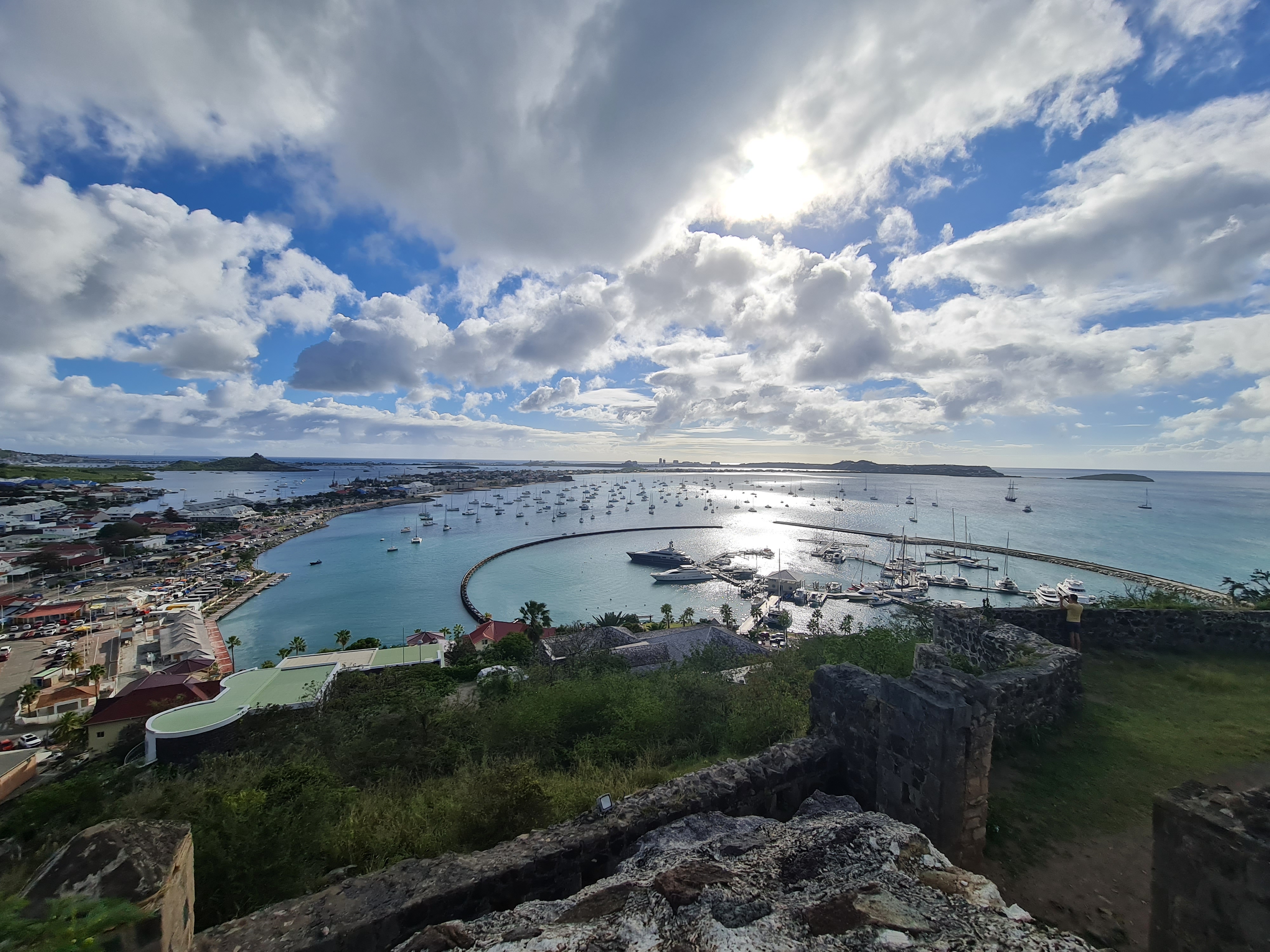
There is a moment, in every anchorage in the Mediterranean between June and September, that repeats with the reliability of a Greek tragedy. A gleaming white charter catamaran motors in, drops the hook in eight metres of water, reverses gently for about four seconds, and shuts down the engine. Twenty metres of chain. Maybe twenty-five. The crew opens the rosé.
The children are already in the water. Someone has connected a Bluetooth speaker to a device that is playing music in only the loosest sense of the word. Life is beautiful. Physics, however, has been notified.
By 3 AM, when the Meltemi — or the Mistral, depending on which end of the Mediterranean you’ve chosen for your holiday — has ideas of its own, that catamaran will be sitting on the beach. And the skipper will tell the charter company it was “a sudden storm nobody predicted” — which it was, if by “nobody” you mean “nobody who looked at the forecast.”
But the wind is not the villain of this story. The chain is. Or rather, the spectacular misunderstanding of what a chain does, why it does it, and how much of it you need. A misunderstanding that has persisted, in various forms of folk wisdom, since approximately 1808 — which is when we started using chain in the first place.
I. A Captain and His Obsession
Before 1808, ships anchored with hemp cable. This worked about as well as you’d expect from a natural fibre asked to hold a 400-ton vessel against an Atlantic gale while being sawed back and forth across a rocky bottom. Chafing was the primary failure mode. Ships didn’t drag — they simply sawed through their own rode, then drifted into each other in a kind of slow-motion wooden bumper-car tournament.
Captain Samuel Brown of the Royal Navy found this intolerable. He had spent years experimenting with wrought iron chain as an alternative to rope for ships’ rigging and mooring lines [1]. In 1808, he took out patents for wrought iron chain links, joining shackles, and swivels — his shackle design was scarcely improved upon for the next hundred years [2]. He equipped the merchantman Penelope with iron anchor cable and sent her to the West Indies, presumably telling the crew that if the chain failed, at least they’d die in the name of progress.
It didn’t fail. The Admiralty ran trials, and by 1812 Brown had established a company with his cousin Samuel Lenox at Millwall in east London [1]. The firm went on to supply all the chain to the Royal Navy until 1916, and made the chains for Brunel’s SS Great Eastern [2]. Brown died in 1852 knowing he had won. You can still visit him at West Norwood Cemetery, Norwood Road, London SE27 9JU — though he is unlikely to be impressed by your scope ratio.
What Brown could not have predicted is that two centuries later, his invention would be deployed by weekend sailors with all the technical understanding of a labrador retriever playing with a garden hose.
II. What a Modern Chain Actually Is
A modern anchor chain is a deceptively simple object. It is a series of welded steel links, hot-dip galvanised against corrosion, manufactured to ISO 4565 or DIN 766 standards that almost nobody reads [3].
The grades that matter:
| Property | Grade 40 (ISO 4565) | Grade 70 (heat-treated) |
|---|---|---|
| 8mm breaking load | ~4,300 kg | ~7,100 kg |
| 10mm breaking load | ~6,400 kg | ~11,200 kg |
| 12mm breaking load | ~9,200 kg | ~16,100 kg |
| Weight per metre (10mm, in air) | ~2.2 kg | ~2.2 kg |
Source: Jimmy Green Marine calibrated chain specifications [3]; MF DAMS Grade 70 data [4]
Grade 70 is produced from Grade 40 steel through a heat treatment process — quenching and tempering — which gives it roughly 65–75% more breaking strength at the same diameter [4]. An 8mm G70 chain is broadly equivalent in breaking strength to a 10mm G40. This matters because chain weight is the whole game, as we shall see.
Stainless steel is also available and looks magnificent on a Hallberg-Rassy. It is weaker than galvanised steel of the same grade, more expensive, and — here is the part nobody mentions — still corrodes. Stainless steel is not stain-proof steel. It relies on a chromium oxide layer that needs oxygen to regenerate. Leave it sitting in a wet, salty chain locker for a season — salt crystals wedged between links, no airflow, no rinse — and the chromium oxide layer quietly gives up. You get crevice corrosion in exactly the joints you can’t inspect, on the chain you assumed was maintenance-free because it was expensive. It is the marine equivalent of buying a titanium watch and then leaving it in a jar of pickle juice. But it does look lovely on the way down.
Calibrated chain has links manufactured to precise tolerances so they fit a windlass gypsy. Non-calibrated chain is cheaper and will jam in your windlass at the worst possible moment, which is always 3 AM.
And now the oldest cliché in engineering: a chain is only as strong as its weakest link. The question is whether this is literally true.
It is. But the weakest link is not where you think. The chain itself, link by link, is tested to ISO specification. The shackle connecting the chain to the anchor is typically rated lower. The swivel, if you use one, is often weaker still. And the anchor shank — the steel arm connecting the shackle to the actual holding mechanism — is a single piece of cast or forged metal that, in cheaper anchors, has the metallurgical integrity of a park bench.
But the actual weakest link in most anchoring systems is the one nobody thinks about: the windlass. A typical recreational windlass is sized so that its maximum pull is roughly three times the total ground tackle weight [5] — which for a 40-foot boat works out to a working capacity of perhaps 400–700 kg. Your 10mm G40 chain breaks at 6,400 kg. Your windlass gives up at 700. This is not a safety margin. This is a confession.
As West Marine and Lofrans both warn: do not rely on the windlass as a high-load-bearing strongpoint; secure the chain to a chain stopper, cleat, or bollard when lying at anchor [5]. Most people don’t. This is where the snubber enters the story — but we’ll get to that.
III. The Catenary: A Curve Worth Understanding
Here is where the Sunday skipper’s education usually ends: “Drop the anchor. Let out three times the depth. Done.” This advice, still taught in the French permis côtier coastal exam as the minimum scope ratio [6], is not so much wrong as it is dangerously incomplete. It is the equivalent of teaching someone to drive by saying “point the car at the road and press the right pedal.”
The three-times rule comes from France. The RYA teaches four-to-one for chain [7]. The Americans and Australians often quote five-to-one. Offshore cruising guides recommend seven-to-one. Notice the pattern? Every institution that studies the problem more carefully arrives at a larger number. This is not a coincidence. It is the progressive discovery of catenary physics.
What is catenary?
When you hang a chain between two points, it forms a curve. Not a parabola — Galileo noted in Two New Sciences (1638) that it was only approximately a parabola [8]. Joachim Jungius proved it was not a parabola at all; his result was published posthumously in 1669 [8]. Christiaan Huygens coined the term catenaria in a letter to Leibniz in November 1690 [9]. And in June 1691, three of the finest mathematical minds of the age — Leibniz, Huygens, and Johann Bernoulli — independently published the true equation in the Acta Eruditorum [8][9]:
where a = TH / (w · g)
TH is the horizontal tension at the lowest point, w is the mass per unit length of the chain, and g is gravity. The parameter a describes how “flat” or “droopy” the curve is. Heavy chain = small a = more droop. The equation took three of history’s greatest mathematicians to derive. And it is the most important equation in anchoring that almost nobody has heard of.
Why it matters:
When your anchor chain hangs in a catenary between the bow roller and the seabed, three things happen simultaneously:
1. The chain’s weight keeps the angle low. At the anchor end, the pull must be as close to horizontal as possible. A horizontal pull drives the flukes deeper. A vertical pull extracts them. The catenary curve, shaped by the chain’s own weight, naturally flattens the angle at the bottom.
2. The chain stores energy. A catenary has more chain length than a straight line between the same two points. When a gust hits, the boat surges forward and the chain must straighten — but straightening means lifting chain, which requires energy. The chain acts as a spring.
3. Chain lying on the bottom adds friction. Every link on the seabed resists movement. The friction coefficient of chain on sand is approximately 0.5–0.7 [10]. However — and this is the uncomfortable truth — the friction effect is modest. Each metre of 10mm chain on the seabed contributes about 1 kg of frictional resistance. Ten metres on the bottom: 10 kg. In 25 knots of wind, you need over 100 kg.
The horizontal force:
Where does it come from? Wind. The aerodynamic drag on your boat:
Where ρ = 1.225 kg/m³, Cd ≈ 1.0–1.2 for a bluff body [11], A = windage area (m²), and v = wind speed (m/s).
Now, our charter catamaran is not a monohull. A Lagoon 40 or Bali 4.0 — the workhorses of the Mediterranean charter fleet — presents roughly 18–22 m² of windage to the wind: double the beam, higher freeboard, a hardtop or flybridge, and the aerodynamic profile of a small apartment building. Let’s use 18 m², which is conservative for a catamaran with a bimini up. For comparison, a typical 40-foot monohull presents about 12 m².
| Wind speed | Force (monohull, 12 m²) | Force (catamaran, 18 m²) |
|---|---|---|
| 10 kn (5.1 m/s) | ~19 kg (190 N) | ~29 kg (285 N) |
| 15 kn (7.7 m/s) | ~44 kg (431 N) | ~65 kg (638 N) |
| 20 kn (10.3 m/s) | ~78 kg (765 N) | ~117 kg (1,148 N) |
| 30 kn (15.4 m/s) | ~175 kg (1,716 N) | ~262 kg (2,570 N) |
| 40 kn (20.6 m/s) | ~312 kg (3,061 N) | ~468 kg (4,591 N) |
The catamaran generates 50% more load at every wind speed. Notice the quadratic relationship: double the wind, quadruple the force. This matters.
When catenary fails:
Here is the number that should keep you awake. The maximum horizontal force a catenary can absorb before going bar-taut [10]:
Where w is the submerged chain weight per metre, L is chain deployed, and d is water depth.
A note on weight: 10mm chain weighs about 2.2 kg/m in air, but it is submerged in seawater (density ~1,025 kg/m³), and steel has a density of ~7,800 kg/m³. Buoyancy reduces the effective weight to about 87% of the air weight — roughly 1.9 kg/m, or 19 N/m [11]. Every catenary calculation in this article uses submerged weight, because the chain doesn’t care what it weighs on the dock. It cares what it weighs in the water.
Our charter catamaran: 20 metres of 10mm chain in 8 metres of water:
Forty-one kilograms. The catamaran generates 41 kg of force at approximately 12 knots. Twelve knots. The catenary on our charter catamaran is gone before the wind is strong enough to sail in. The crew hasn’t finished the first glass of rosé. The children are still arguing about who gets the inflatable flamingo.
As Peter Smith’s anchor analysis demonstrates: at 20 knots some catenary remains visible, but by 50 knots “the catenary has all but disappeared, and the angle of pull on the anchor is dictated primarily by the scope, not the weight of the chain” [10].
IV. The Angle of Truth
Once the catenary is gone — and in most realistic wind scenarios it goes rather quickly — what matters is pure geometry. Specifically: the angle at which the chain pulls on the anchor.
| Scope | Chain angle at anchor | Upward force (% of horizontal) |
|---|---|---|
| 3:1 | ~19° | ~34% |
| 4:1 | ~14° | ~25% |
| 5:1 | ~11° | ~20% |
| 7:1 | ~8° | ~14% |
| 10:1 | ~6° | ~10% |
An anchor buried in sand at 19° is experiencing an upward force component equal to about a third of the horizontal force. That upward component is doing exactly one thing: trying to lever the anchor out of the seabed.
Think of a tent peg. Push it sideways — the ground resists. Pull it upward — it slides out. An anchor is a tent peg with ambitions and a mortgage. The moment you start pulling up instead of along, you are conducting an involuntary extraction experiment.
But here is the subtlety that the scope tables don’t show.
The bar-taut angle depends only on the scope ratio. The depth cancels out:
angle = arcsin(1/3) ≈ 19.5°
Identical at 3 metres or 20 metres. Pure geometry. So a 3:1 scope produces the same ugly 19° pull whether you’re in a shallow Balearic cove or a deep Norwegian fjord.
What changes — dramatically — is how quickly you get there. Recall the catenary limit. At 3:1 scope this simplifies to TH max = 4wd — linear in depth. More depth means more chain in the water, more weight, more catenary to burn through before the rode goes bar-taut.
| Depth | Chain at 3:1 | Catenary holds until | Wind speed at failure |
|---|---|---|---|
| 3m | 9m | ~23 kg (228 N) | ~11 knots |
| 8m | 24m | ~62 kg (608 N) | ~18 knots |
| 15m | 45m | ~117 kg (1,147 N) | ~24 knots |
| 20m | 60m | ~155 kg (1,520 N) | ~28 knots |
10mm chain, submerged weight 1.9 kg/m; catamaran, 18 m² windage
Read that table carefully. In 3 metres of water at 3:1 — a perfectly typical depth for a lunchtime swim stop — the catenary is gone at 11 knots. Eleven knots. That is not wind. That is what the French call une brise légère and the rest of us call “pleasant.” Nine metres of chain, bar-taut, pulling at 19°, in conditions that wouldn’t spill your rosé.
In 20 metres at the same ratio, the catenary survives to 28 knots. Four times the depth, four times the chain weight, four times the energy budget.
The typical Mediterranean anchorage — 3 to 8 metres, sand bottom, afternoon thermal building to 15–20 knots by late afternoon — is precisely where 3:1 fails fastest. The catenary evaporates in the lightest conditions, the chain snaps taut, and the full 19° angle arrives before anyone notices the wind has picked up. This is not a deep-water problem. It is a shallow-water problem, in exactly the anchorages where most people anchor.
Peter Smith’s scope analysis confirms: there is measurable benefit up to about 8:1, beyond which gains become marginal [10]. The French 3:1 minimum works in flat calm. It barely works in the Îles de Lérins once the afternoon wind fills in. And it does not work at all in the Strait of Bonifacio when the Mistral decides to visit, or in the Cyclades in July, where the Meltemi has a sense of humour and you don’t.
V. What the Anchor Actually Does
Anchors are not weights. This is the foundational misunderstanding of the Sunday skipper who drops a 15 kg lump of galvanised steel and expects it to hold a 10-tonne boat by sheer mass. That is not how any of this works.
An anchor is a plough. It works by burying itself in the seabed and mobilising a large volume of soil or sand to resist movement. Its holding power depends on fluke area, burial depth, soil type, and — above all — the angle of pull [12].
Comparative tests have been conducted by West Marine (2006), Practical Boat Owner (2011, John Knox), Voile magazine (2012), and Kippari (2015) [12]. The numbers are consistent and sobering:
West Marine 2006 field tests:
| Anchor | Weight | Holding power in sand |
|---|---|---|
| Rocna 15 | 15 kg | >2,000 kg (4,500 lb), set immediately |
| Delta 35 | 16 kg | 680–2,000 kg (variable, inconsistent) |
| CQR anchor 35 | 17.5 kg | “One promising set to 900 kg, but little else” |
The CQR anchor — a phonetic play on “secure,” say it quickly — is a plough anchor patented in 1933 by Professor Geoffrey Ingram Taylor, a Cambridge physicist who later witnessed the Trinity nuclear test as one of the few British scientists present at the Manhattan Project. He can perhaps be forgiven for not revisiting his anchor design. The CQR anchor was the gold standard for half a century and is still fitted to thousands of charter boats. The test results suggest it has been living on its reputation.
The Practical Boat Owner test found the Rocna 15 climbing toward a normalised holding force of ~480 kg, while the CQR anchor “never exceeded 175 kg” at the same weight class [12]. Mantus anchors were shown to “set faster and deeper than other tested anchors, including Rocna, Bruce, and CQR anchor” [12].
Modern new-generation anchors (Rocna, Mantus, Spade, Ultra) have roll bars that force correct orientation, concave flukes that resist backing out, and shank geometry optimised for tip-loading. They are engineered to bury themselves immediately and resist extraction. The old-generation designs (CQR anchor, Bruce, Danforth) were designed when anchors sat on the seabed and relied on weight and catenary to stay put. The new designs assume the catenary will fail — because it will — and are built to hold anyway.
The irony is exquisite: the worse your anchoring technique (short scope, high angle), the more you need a modern anchor. And the people most likely to use a modern anchor are the experienced sailors who already deploy proper scope. The charter catamaran with the CQR anchor and 20 metres of chain is exactly the boat that needs a Rocna and 40 metres of chain. It is also, by a remarkable coincidence, the boat that will never have either.
VI. The Snubber: The Best Spring You’re Not Using
Once the catenary vanishes — and we’ve established that this happens somewhere between 11 and 18 knots for most setups — the rode goes bar-taut. Steel chain does not stretch. The load path runs from the anchor, through rigid chain, straight into the windlass gypsy.
Remember the windlass? The one rated for 400–700 kg? It is now absorbing every gust, every wave surge, every dynamic snatch load that the ocean can produce. Dynamic loads from gusts and wave action can reach 2–3 times the steady-state wind force [13]. In 30 knots of steady wind (175 kg steady load on a monohull, 262 kg on the catamaran), peak snatch loads may reach 350–750 kg. Your bow roller fittings are having a quiet existential crisis.
This is where the snubber comes in. And it is not optional. It is arguably the single most important piece of equipment in the entire anchoring system after the anchor itself.
What a snubber does:
A snubber is a length of three-strand nylon line — typically 8–15 metres — attached to the chain via a hook or rolling hitch forward of the bow roller, and secured to a bow cleat. Once deployed, you pay out enough chain to transfer the load from the windlass to the snubber. The chain between the snubber hook and the bow roller goes slack. The windlass bears zero load.
The load is now transferred to the bow cleat, which — if properly through-bolted — is rated for many tonnes. You have just bypassed the weakest link in your system. With a piece of rope. Captain Brown would approve.
But the snubber does far more than that.
The spring rate comparison — this is the key:
Let’s compare the “spring rate” (stiffness in N/m) of the chain catenary versus a nylon snubber. This is the number that tells you how much energy each system can absorb.
Chain catenary spring rate: The catenary acts as a nonlinear spring. When chain has significant sag, a small increase in horizontal force lifts chain off the seabed — large displacement, low stiffness. As the chain approaches bar-taut, stiffness goes to infinity (steel doesn’t stretch). In the useful working range, the effective spring rate of a catenary is roughly 200–500 N/m.
Nylon snubber spring rate: Three-strand nylon elongates approximately 2.5% at 10% of breaking load, and about 16% at 50% of breaking load [14][15]. The relationship is nonlinear — nylon gets stiffer as load increases. For a 16mm, 10-metre snubber (breaking load ~5,300 kg [15]):
- At working load (530 kg / 5,200 N), elongation ~2.5% = 0.25m
- Spring rate: k = 5,200 / 0.25 = ~20,000 N/m
At first glance, the nylon snubber (20,000 N/m) looks far stiffer than the catenary (200–500 N/m). The catenary appears to be the better spring. And it is — while it exists. But here is the critical difference:
The catenary spring has a finite stroke. Once the chain is straight, it stops working entirely. The spring rate jumps from 500 N/m to effectively infinite — rigid steel. No absorption. Every shock goes straight through. It is the mechanical equivalent of a bungee cord that, at full extension, becomes a steel cable. One moment you’re bouncing gently. The next, something breaks.
The nylon snubber keeps working after the catenary fails. When the chain goes bar-taut, the snubber is still stretching, still absorbing energy, still protecting the windlass, the cleats, the anchor, and your sleep. At 20,000 N/m it is stiffer than the catenary was, yes — but it is infinitely softer than a rigid steel chain, which is the alternative.
Energy storage comparison:
The elastic potential energy stored in a spring is PE = ½ · k · x².
- Catenary lifting 5m of chain 1m off the seabed: ~95 J
- Nylon snubber (16mm × 10m) at working load: ~650 J [16]
- Nylon snubber (16mm × 10m) at 30% of breaking load: ~3,500 J
The snubber stores roughly 7 times more energy at working loads, and 35 times more at storm loads. A 30-foot (9m) nylon bridle can reduce peak loads by 62% compared to bare chain [13]. A six-foot snubber achieves only a 22% reduction [13]. Length matters — this is not the place to economise.
What diameter?
The snubber must be at least as strong as the windlass — which is easy, since even 12mm nylon breaks at ~3,400 kg [15]. But ideally, you want the snubber to approach the chain’s breaking strength, because optimism is not a structural material.
| Nylon diameter | Breaking load | Matches chain |
|---|---|---|
| 12mm | ~3,400 kg | exceeds most windlasses |
| 14mm | ~4,000 kg | approaches 8mm G40 (4,300 kg) |
| 16mm | ~5,300 kg | approaches 10mm G40 (6,400 kg) |
| 18mm | ~7,800 kg | exceeds 10mm G40 |
LIROS three-strand nylon breaking loads [15]
Jimmy Green recommends a snubber diameter one size down from what you’d use as an anchor warp, because the thinner line stretches more at a given load, absorbing more energy [14]. For 10mm chain, that means 14–16mm nylon. For 8mm chain, 12–14mm.
Here is the subtle trade-off. A thinner snubber stretches more per unit load — lower spring rate, better shock absorption. A thicker snubber has a higher breaking load — more margin before failure. In practice, for a 40-foot boat with 10mm chain, a 16mm × 10m three-strand nylon snubber is the sweet spot: strong enough to survive anything short of chain failure, elastic enough to absorb storm gusts without shattering your bow fittings. It costs about forty euros. Less than the second bottle of rosé. Less than the excess on your charter insurance. Less than the phone call to your wife explaining why the boat is now a garden feature on a Sardinian beach.
VII. What the Seabed Actually Contributes
One of the comforting myths of anchoring is that chain lying on the seabed provides substantial friction. It does — just not as much as you think.
The friction coefficient of chain on sand is approximately 0.5–0.7 [10]. For 10mm chain (submerged weight ~1.9 kg/m), each metre on the bottom contributes about 1 kg of frictional resistance.
| Chain on seabed | Friction force |
|---|---|
| 5 metres | ~5 kg |
| 10 metres | ~10 kg |
| 20 metres | ~20 kg |
In 15 knots of wind, you need ~20 kg of resistance. In 25 knots, ~100 kg. In 30 knots, ~175 kg. You would need over 100 metres of chain on the seabed to resist a 30-knot wind by friction alone.
Now, the friction force per metre of chain is depth-independent — it is simply submerged weight times friction coefficient, and that number doesn’t change whether you’re in 3 metres or 30. But here is where depth helps indirectly: at the same scope ratio, deeper water means more chain deployed. 3:1 in 3 metres is 9 metres of chain. 3:1 in 20 metres is 60 metres. While catenary exists, the excess chain lies on the seabed, and 60 metres puts a lot more chain on the bottom than 9. So deep water buys you more friction — not because the friction per metre changes, but because there is simply more chain down there.
The problem is that this advantage evaporates along with the catenary. Once the rode goes bar-taut, the chain lifts off the bottom regardless of depth. At that point, friction contributes nothing. The catenary effect, by contrast, scales linearly with depth in a way that matters: more chain weight means more energy required to straighten the rode, which means the catenary survives to higher wind speeds. Deep water is your friend three times over: more catenary energy, more chain on the bottom while catenary exists, and better geometry from longer rode lengths. Shallow water gives you none of these.
The cruel irony of chain friction is that it only works when you don’t need it. In light winds, when the catenary holds and chain lies peacefully on the sand, friction contributes its modest few kilograms. The moment the wind rises and you actually need every newton of resistance you can get, the chain lifts off the bottom and the friction vanishes — precisely when it would matter most.
It exists. It helps, a little, in conditions where you were never in danger. It is the bouncer who only works the door on quiet Tuesdays.
What keeps you off the beach is the anchor, buried in the seabed, resisting the horizontal force that the chain transmits to it. Everything else — the catenary, the friction, the weight of the chain — is a supporting actor. The anchor is the star. And as Peter Smith notes, increasing chain beyond approximately two-thirds of total rode length provides only marginal benefit — a 50% increase in chain weight yields roughly a 10% performance gain [10].
VIII. How to Anchor Like You Mean It
You’ve motored into an anchorage. The depth sounder reads 8 metres. What do you actually do?
Step 1: Choose the bottom. Sand is best. Mud is acceptable but holding is lower. Weed and posidonia are treacherous — anchors skip across them like a stone on water. Rock is a lottery. If you can see the bottom, choose sand. If you can’t see the bottom, assume it’s the worst option and plan accordingly.
Step 2: Calculate scope. Not a single magic number, but a function of conditions. The French permis côtier minimum of 3:1 is for a lunchtime stop in flat calm [6]. For an overnight stay with forecast wind above 15 knots, you need 5:1 minimum. For anything above 25 knots, 7:1 [7][10]. Account for tidal range: at high tide your effective depth increases and your scope decreases. If your scope drops below 4:1 at high tide with rising wind, you don’t have enough chain out.
For our 40-footer in 8m with 25 knots forecast overnight:
- 5:1 = 40 metres (minimum)
- 7:1 = 56 metres (comfortable)
Step 3: Set the anchor. Motor forward over your chosen spot. Stop. Lower the anchor to the bottom — do not throw it, do not drop it from ten metres, and above all do not let the chain pile up on top of it in a heap that will prevent the flukes from setting. An anchor buried under its own chain is not anchored. It is merely stored on the seabed, temporarily. Reverse slowly while paying out chain. At target length, increase reverse thrust to 1,500 RPM for 30 seconds. Watch the GPS. Position stable = anchor set. Position creeping = it hasn’t. Reset.
The majority of dragging incidents begin not at 3 AM in a squall, but at the moment of anchoring, when the crew failed to verify the set. A 30-second reverse test at moderate RPM is the cheapest insurance in sailing.
Step 4: Deploy the snubber. Attach a rolling hitch or chain hook 3–5 metres below the bow roller. Secure the nylon snubber to the bow cleat. Pay out chain until the snubber takes the load and the chain between hook and bow roller hangs slack. The windlass is now unloaded. You are now anchored like someone who has read this article.
Step 5: Record and monitor. Chain deployed. Depth. Scope ratio. Tidal range. Wind forecast. Anchor alarm on. Then — and only then — open the rosé. You have earned it. The charter catamaran behind you has not.
IX. The Traditions We Inherited
The scope ratios from various sailing schools are not wrong so much as they are incomplete.
| Source | Recommended scope (chain) | Context |
|---|---|---|
| French permis côtier | 3:1 minimum | Coastal, moderate conditions |
| RYA | 4:1 chain, 6:1 mixed | Standard recommendation |
| US cruising / USCG | 5:1 to 7:1 | General practice |
| Offshore / heavy weather | 7:1 to 10:1 | Storm preparation |
Source: SVB anchoring guide [6]; Yachting Monthly [7]; Peter Smith scope analysis [10]
The RYA’s recommendation of 6:1 for mixed rope-and-chain rode acknowledges that rope, being lighter, produces less catenary and therefore needs more scope to achieve the same geometry. This is one of the few institutional recommendations that reflects actual physics rather than tradition.
What none of these single numbers capture is the full picture. The correct amount of chain depends on depth, chain weight, windage area, expected wind speed, bottom type, anchor type, and tidal range. A single ratio cannot encode all of this. “Five times the depth” is a heuristic that works often enough to survive as received wisdom, but fails precisely when it matters most: in strong wind, in shallow water, in exposed anchorages. The places where you actually need to get it right.
X. The Breaking Point
One final number. The breaking load of 10mm G40 chain is approximately 6,400 kg [3]. The working load limit, with a 4:1 safety factor, is about 1,600 kg.
At what wind speed does our catamaran with 18 m² windage generate 1,600 kg of horizontal force?
v = √(2 · 15,696 / (1.225 · 1.0 · 18))
v = √(1,424)
v ≈ 38 m/s ≈ 74 knots
Your chain will not break in any wind you are likely to survive. This is both reassuring and misleading, because the chain was never the weak link.
The failure cascade, when it happens, goes like this:
- Catenary vanishes (11–18 knots, depending on depth and scope)
- Chain goes bar-taut
- Without snubber: shock loads hammer the windlass
- Angle increases with every gust-driven surge
- Anchor holding power decreases as the pull tilts upward
- Anchor begins to skip across the bottom like a credit card being declined
- You are now a very expensive dinghy
The chain doesn’t break. The physics just stops cooperating.
Epilogue
Captain Brown solved the problem of hemp cable chafing through on rocks. He gave us chain — stronger, more durable, and more resistant to abrasion than anything that came before. What he could not give us is the understanding of what that chain does once it’s in the water.
A chain is not a leash. It is a catenary spring, a geometry engine, a force transmitter, and — when paired with a proper snubber and a modern anchor deployed at adequate scope — the difference between sleeping soundly and swimming to shore. The curve it makes in the water is not decorative. It is load-bearing mathematics, and it has been keeping ships off the rocks since Leibniz proved it wasn’t a parabola.
The next time you watch a charter catamaran drop 20 metres of chain in 3 metres of water, with no snubber, a vintage CQR anchor, and a confident skipper cracking open the rosé, you’ll know exactly what’s coming. You’ll know the catenary will fail at 11 knots. You’ll know the chain angle will be 19° and climbing. You’ll know the windlass is bearing every newton. And you’ll know the anchor is developing about a quarter of the holding power it could produce with proper scope and a decent burial angle.
Captain Brown, from somewhere in 1852, is shaking his head. He did not patent wrought iron chain links so that a man in board shorts could ignore them in favour of rosé.
References
[1] Wikipedia, “Samuel Brown (Royal Navy officer)”
[2] Undiscovered Scotland, “Captain Samuel Brown”; Graces Guide
[3] Jimmy Green Marine, ISO 4565 / DIN 766 calibrated chain specifications
[4] Jimmy Green Marine, MF DAMS Grade 70 galvanised chain
[5] West Marine, “Selecting an Anchor Windlass”; Lofrans windlass guidelines
[6] permis-hauturier.info, “Le mouillage forain”; SVB anchoring guide
[7] Yachting Monthly, “How much anchor chain?”
[8] Wikipedia, “Catenary”; MacTutor History of Mathematics
[9] Huygens’ November 1690 letter coining catenaria; Leibniz, Bernoulli, Huygens solutions published Acta Eruditorum, June 1691. Primary source translation
[10] Peter Smith, “Catenary & Scope In Anchor Rode”
[11] Wind force on vessels: standard aerodynamic drag equation per ABYC and ISO 15083 windage calculations. Buoyancy factor: steel density 7,800 kg/m³, seawater 1,025 kg/m³.
[12] Peter Smith, “Independent Anchor Performance Testing”; summarising West Marine (2006), PBO/Knox (2011), Voile (2012), Kippari (2015)
[13] Mantus Marine, snubber/bridle guidance; 48 North Marine; Practical Sailor snubber shock load test
[14] Jimmy Green Marine, anchor snubbing advice
[15] LIROS 3-strand nylon specifications via Jimmy Green Marine; Engineering Toolbox, nylon rope strength
[16] Elastic potential energy PE = ½kx²; nylon elongation data from [14][15]; Samson Rope, elastic stiffness bulletin

Leave a Reply