


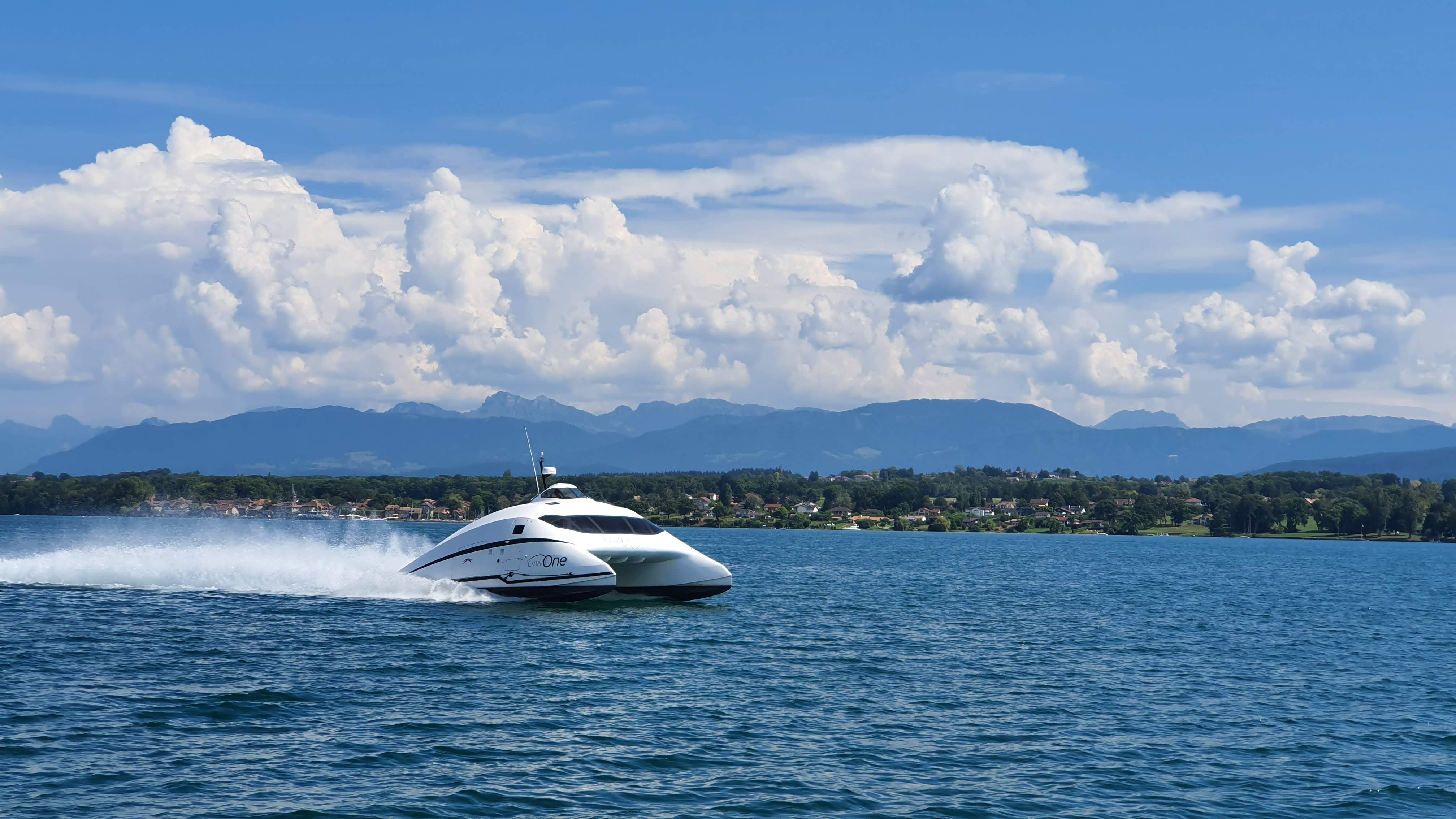
The complete legal framework that keeps you from hitting things — and why reading just one rule is like reading just one chapter of a murder mystery.
Disclaimer: This article is provided for educational and informational purposes only. It does not constitute legal, maritime, or professional navigation advice. The International Regulations for Preventing Collisions at Sea (COLREGs) are complex regulations that vary in implementation across jurisdictions. This content is a simplified overview and does not replace the full text of the regulations, official IMO publications, national maritime legislation, or professional training.
The Scene
It is a Saturday afternoon in July. The Strait of Bonifacio, seven nautical miles of blue chaos between Corsica and Sardinia. Wind is 18 knots from the west, gusting 25. Visibility is excellent. The strait is packed: three ferries on schedule, a superyacht doing twelve knots with nobody on the flybridge, a flotilla of charter cats tacking in formation like confused geese, and you — beating into the wind on port tack, coffee in hand, autopilot on, wondering if that AIS target at 2.3 miles is going to be a problem.
It is going to be a problem.
Somewhere in the back of your mind, a voice says: “Starboard tack has right of way.” And you are correct. Rule 12. Sailing vessels. Port tack gives way to starboard tack. You learned this in your day skipper course. The instructor had a diagram with two little boat arrows on a whiteboard.
What the instructor did not mention — because there was lunch to get to — is that Rule 12 does not exist in a vacuum. It exists inside a system of seventeen interlocking rules, each one modifying, constraining, or occasionally contradicting the others. Cherry-picking the one that suits you is the maritime equivalent of reading the Second Amendment without reading the rest of the Constitution. You will end up confident, loud, and wrong.
So let us read the whole thing.
Why You Cannot Read One Rule
The COLREGs — the Convention on the International Regulations for Preventing Collisions at Sea — were adopted by the IMO in 1972 and entered into force in 1977. They have been amended several times since, most recently through various resolutions addressing traffic separation schemes and vessel lighting. They apply to every vessel on the high seas and on all waters connected therewith navigable by seagoing vessels.
Every vessel. Your 52-footer. The container ship. The fishing boat. The kayak. The superyacht whose captain is below making espresso.
The collision avoidance rules live in Part B of the COLREGs, spanning Rules 4 through 19. They are organised in three sections:
- Section I (Rules 4–10): Conduct in any condition of visibility
- Section II (Rules 11–18): Conduct of vessels in sight of one another
- Section III (Rule 19): Conduct in restricted visibility — vessels not in sight of one another
Above all of these sits Rule 2 — Responsibility, which is the closest thing maritime law has to a philosophical statement. It says, in essence: these rules are not an excuse. You cannot follow the rules perfectly and still claim innocence if you failed to exercise the ordinary practice of good seamanship. The rules are a minimum standard, not a maximum one.
This matters. A court will not care that you technically had right of way if you sailed into an obviously developing collision while sipping your Aperol Spritz. Rule 2 is the legal trapdoor beneath every other rule in the book.
Let us walk through the system, in order, because order matters.
The Foundation: Rules That Apply Always
These rules apply in all conditions of visibility — fog, sunshine, midnight, noon. They are the permanent background hum of the system. Everything else is built on top of them.
Rule 2 — Responsibility
The preamble rule. The one that says the rules themselves are not enough.
(a) Nothing in these Rules shall exonerate any vessel, or the owner, master, or crew thereof, from the consequences of any neglect to comply with these Rules or of the neglect of any precaution which may be required by the ordinary practice of seamen, or by the special circumstances of the case.
(b) In construing and complying with these Rules, due regard shall be had to all dangers of navigation and collision and to any special circumstances, including the limitations of the vessels involved, which may make a departure from these Rules necessary to avoid immediate danger.
Translation: follow the rules, but if the rules are about to get you killed, break the rules. And if you follow the rules but forget basic seamanship, the rules will not save you in court.
This is the most important rule in the book. It is also the one most people skip because it sounds like a legal disclaimer. It is not a disclaimer. It is the philosophical foundation of the entire system.
Rule 4 — Application
Section I applies in any condition of visibility.
That is the entire rule. One sentence. It exists to make sure you understand that Rules 5 through 10 are always on. There is no weather condition, time of day, or state of mind that switches them off.
Rule 5 — Look-out
Every vessel shall at all times maintain a proper look-out by sight and hearing as well as by all available means appropriate in the prevailing circumstances and conditions so as to make a full appraisal of the situation and of the risk of collision.
One sentence. Forty-four words. The single most violated rule in recreational sailing.
“All available means” does not mean glancing up from the chartplotter every few minutes. It means eyes, ears, radar, AIS, binoculars, and the crew member you posted as lookout (you did post a lookout, didn’t you?). And no, your autopilot is not a lookout. It steers a course. It does not look where it is going. “At all times” means at all times. Not “when you feel like it.” Not “when you’re not making lunch.” Not “when you’re not below adjusting the nav station.” Not “when you’re sitting on the toilet.” Not “when you’re trying to unclog the holding tank valve with both hands.” Not “when you’re FaceTiming your mother-in-law from the companionway.” The IMO did not include a bathroom exemption. Rule 5 follows you into the toilet. It is also, not coincidentally, the most searched COLREG rule on the internet — quite possibly from the toilet itself.
Accident investigations consistently find that the primary cause of recreational vessel collisions is failure to keep a proper lookout. Not equipment failure. Not bad weather. Not confusing rules. Just nobody looking.
Rule 6 — Safe Speed
Every vessel shall at all times proceed at a safe speed so that she can take proper and effective action to avoid collision and be stopped within a distance appropriate to the prevailing circumstances and conditions.
The rule then lists factors to consider: visibility, traffic density, manoeuvrability of the vessel (with special reference to stopping distance and turning ability), background light at night, state of wind/sea/current, proximity of navigational hazards, and the draft of the vessel in relation to the available depth of water.
For vessels with radar, additional factors include: the characteristics, efficiency, and limitations of your radar equipment; any constraints imposed by the radar range in use; the effect of sea state, weather, and other sources of interference on radar detection; the possibility that small vessels, ice, and other floating objects may not be detected at adequate range; and the number, location, and movement of vessels detected by radar.
“Safe speed” is not a number. It is a judgment. A speed that is safe in open water with good visibility is not safe in a crowded anchorage approach in fog. The same vessel, the same engine, the same helmsman — different circumstances require different speeds. If you cannot stop or turn in time to avoid a collision, you are going too fast. Full stop.
Rule 7 — Risk of Collision
(a) Every vessel shall use all available means appropriate to the prevailing circumstances and conditions to determine if risk of collision exists. If there is any doubt, such risk shall be deemed to exist.
(b) Proper use shall be made of radar equipment if fitted and operational, including long-range scanning to obtain early warning of risk of collision and radar plotting or equivalent systematic observation of detected objects.
(c) Assumptions shall not be made on the basis of scanty information, especially scanty radar information.
(d) In determining if risk of collision exists the following considerations shall be among those taken into account: (i) such risk shall be deemed to exist if the compass bearing of an approaching vessel does not appreciably change; (ii) such risk may sometimes exist even when an appreciable bearing change is evident, particularly when approaching a very large vessel or a tow or when approaching a vessel at close range.
Paragraph (c) is the one that should be tattooed on the forearm of every sailor who has ever said “I think we’re fine” while staring at an ambiguous AIS target. If the information is scanty, assume the worst. If the bearing is not changing, you are on a collision course. If you are not sure whether the bearing is changing, you are probably on a collision course.
The constant-bearing/decreasing-range test is the oldest trick in the book. Take a bearing on the approaching vessel. Wait. Take another. If the bearing has not changed and the range has decreased, you are converging. This works with a hand bearing compass, a radar, an AIS overlay, or your thumb held at arm’s length against the rigging. No technology required. Just attention.
Rule 8 — Action to Avoid Collision
(a) Any action to avoid collision shall, if the circumstances of the case admit, be positive, made in ample time, and with due regard to the observance of good seamanship.
(b) Any alteration of course and/or speed to avoid collision shall, if the circumstances of the case admit, be large enough to be readily apparent to another vessel observing visually or by radar; a succession of small alterations of course and/or speed should be avoided.
(c) If there is sufficient sea room, alteration of course alone may be the most effective action to avoid a close-quarters situation provided that it is made in good time, is substantial and does not result in another close-quarters situation.
(d) Action taken to avoid collision with another vessel shall be such as to result in passing at a safe distance. The effectiveness of the action shall be checked until the other vessel is finally past and clear.
(e) If necessary to avoid collision or allow more time to assess the situation, a vessel shall slacken her speed or take all way off by stopping or reversing her means of propulsion.
This rule is the antidote to the most common collision avoidance mistake: the timid course change. Five degrees to starboard is not an avoidance manoeuvre. It is a suggestion. The other vessel cannot see it. Their radar cannot detect it. You have not avoided anything — you have merely introduced ambiguity.
Rule 8 demands boldness. Turn thirty degrees. Turn sixty. Slow down dramatically. Stop. Do something obvious. The other vessel needs to see what you are doing and understand your intent. A succession of small, nervous corrections is worse than no action at all, because it signals indecision.
And paragraph (d): you are not done when you turn the wheel. You are done when the other vessel is “finally past and clear.” Monitor the result. If your action is not working, take more action.
Rule 9 — Narrow Channels
(a) A vessel proceeding along the course of a narrow channel or fairway shall keep as near to the outer limit of the channel or fairway which lies on her starboard side as is safe and practicable.
(b) A vessel of less than 20 metres in length or a sailing vessel shall not impede the passage of a vessel which can safely navigate only within a narrow channel or fairway.
(c) A vessel engaged in fishing shall not impede the passage of any other vessel navigating within a narrow channel or fairway.
(d) A vessel shall not cross a narrow channel or fairway if such crossing impedes the passage of a vessel which can safely navigate only within such channel or fairway. The latter vessel may use the sound signal prescribed in Rule 34(d) if in doubt as to the intention of the crossing vessel.
This is where the romantic notion of “sail has right of way over power” runs into a brick wall. Your 14-metre sloop does not have right of way over a 300-metre container ship in a narrow channel. Rule 9(b) says you shall not impede. Not “should not.” Not “try to avoid.” Shall not. The ship cannot leave the channel. You can. End of discussion.
Rule 10 — Traffic Separation Schemes
Similar principle. If a traffic separation scheme is in operation, vessels using it shall proceed in the appropriate traffic lane in the general direction of traffic flow. Crossing shall be done at right angles to the general direction of traffic flow. Vessels of less than 20 metres, sailing vessels, and vessels engaged in fishing shall not impede the safe passage of a power-driven vessel following a traffic lane.
Again: in a TSS, your yacht does not rule the road. The commercial traffic does. Get across cleanly, at right angles, or stay out entirely.
When You Can See Each Other: The Encounter Rules
These are the rules everybody thinks they know. They are also the rules most frequently misapplied, because people remember the diagram but forget the context.
These rules apply ONLY when vessels are in sight of one another. This is the single most important distinction in the entire COLREG system. In sight means you can see the other vessel with your eyes — not just on radar, not just on AIS. If you can only see them electronically, you are not in sight, and Rule 19 (restricted visibility) applies instead. Get this wrong and you are applying the wrong ruleset entirely.
Rule 11 states that Section II applies to vessels in sight of one another. One sentence, but it draws the sharpest line in the regulations: everything in this section — the sailing rules, the overtaking rules, the crossing rules, the hierarchy — switches off the moment you lose visual contact.
Rule 12 — Sailing Vessels
When two sailing vessels are approaching one another so as to involve risk of collision, one of them shall keep out of the way of the other as follows:
(a) When each has the wind on a different side, the vessel which has the wind on the port side shall keep out of the way of the other.
(b) When both have the wind on the same side, the vessel which is to windward shall keep out of the way of the vessel which is to leeward.
(c) If a vessel with the wind on the port side sees a vessel to windward and cannot determine with certainty whether the other vessel has the wind on the port or the starboard side, she shall keep out of the way of the other.
In plain language: port tack gives way to starboard tack. If you are both on the same tack, the windward boat gives way. And if you are on port and you are not sure what the other boat is doing, give way anyway.
This is the rule every sailor learns first. It is also the rule that applies least often in the real world, because the moment either vessel starts their engine, they become a power-driven vessel and Rule 12 drops out of the picture entirely. Most “sailing” encounters in crowded waters are actually power-driven encounters, because most cruising sailors are motor-sailing. Be honest with yourself about which rules actually apply to you.
Rule 13 — Overtaking
(a) Notwithstanding anything contained in the Rules of Section II, any vessel overtaking any other shall keep out of the way of the vessel being overtaken.
Read that first line again. Notwithstanding anything contained in the Rules of Section II. This means the overtaking rule trumps everything else in this section. Sail, power, fishing, not under command — it does not matter. If you are overtaking, you are the give-way vessel. Period.
(b) A vessel shall be deemed to be overtaking when coming up with another vessel from a direction more than 22.5 degrees abaft her beam — that is to say, in such a position with reference to the vessel she is overtaking that at night she would be able to see only the sternlight of that vessel but neither of her sidelights.
(d) Any subsequent alteration of the bearing between the two vessels shall not make the overtaking vessel a crossing vessel within the meaning of these Rules or relieve her of the duty of keeping clear of the overtaken vessel until she is finally past and clear.
Once an overtaking vessel, always an overtaking vessel — for the duration of that encounter. You cannot improve your legal position by changing your angle of approach. The geometry at the moment of encounter defines the relationship. This prevents the manoeuvre of angling slightly to convert yourself from an overtaking vessel (give-way) to a crossing vessel (possibly stand-on). Maritime lawyers call this “creative geometry.” Judges call it “liability.”
Rule 14 — Head-On Situation
When two power-driven vessels are meeting on reciprocal or nearly reciprocal courses so as to involve risk of collision, each shall alter her course to starboard so that each shall pass on the port side of the other.
(b) Such a situation shall be deemed to exist when a vessel sees the other ahead or nearly ahead and by night she could see the masthead lights of the other in a line or nearly in a line and/or both sidelights and by day she observes the corresponding aspect of the other vessel.
(c) When a vessel is in any doubt as to whether such a situation exists she shall assume that it does exist and act accordingly.
Both vessels turn right. Both pass port-to-port. If you are not sure if it is head-on, assume it is. Simple, symmetrical, decisive. This is the one rule that requires identical action from both parties, which is precisely why it works so well and fails so rarely.
Rule 15 — Crossing Situation
When two power-driven vessels are crossing so as to involve risk of collision, the vessel which has the other on her own starboard side shall keep out of the way and shall, if the circumstances of the case admit, avoid crossing ahead of the other vessel.
The vessel to your right has the right of way. You are the give-way vessel. You shall avoid crossing ahead of the stand-on vessel — which means you pass astern, not ahead. This is the crossing situation that produces the most arguments in post-collision debriefs, because the give-way vessel almost always thought they could “make it across.”
They could not.
Rule 16 — Action by Give-Way Vessel
Every vessel which is directed to keep out of the way of another vessel shall, so far as possible, take early and substantial action to keep well clear.
Three adjectives doing heavy lifting: early, substantial, and well clear. Not “eventually.” Not “slightly.” Not “just barely clear.” If you are the give-way vessel, act decisively, act soon, and leave a generous margin. If the stand-on vessel can tell you have taken action, you are probably doing it right. If they cannot tell, you are not.
Rule 17 — Action by Stand-On Vessel
(a)(i) Where one of two vessels is to keep out of the way, the other shall keep her course and speed.
(a)(ii) The latter vessel may, however, take action to avoid collision by her manoeuvre alone, as soon as it becomes apparent to her that the vessel required to keep out of the way is not taking appropriate action in compliance with these Rules.
(b) When, from any cause, the vessel required to keep her course and speed finds herself so close that collision cannot be avoided by the action of the give-way vessel alone, she shall take such action as will best aid to avoid collision.
(c) A power-driven vessel which takes action in a crossing situation in accordance with sub-paragraph (a)(ii) of this Rule to avoid collision with another power-driven vessel shall, if the circumstances of the case admit, not alter course to port for a vessel on her own port side.
Rule 17 is the most misunderstood rule in the book. It creates a three-phase obligation for the stand-on vessel:
Phase 1: Maintain course and speed. You are predictable. The give-way vessel needs to know where you will be.
Phase 2: If the give-way vessel is clearly not acting, you may take avoiding action yourself. This is permission, not obligation.
Phase 3: If collision is now imminent and the give-way vessel’s action alone cannot prevent it, you shall take action. This is obligation, not permission.
The stand-on vessel’s duty to maintain course and speed is not a licence to sail into a collision while shouting “I have right of way!” You had right of way. Then you had the obligation to act. The transition between these phases is where most collisions actually happen — in the gap between “they should be turning” and “oh God, they’re not turning.” Phase 3 has its own sound — usually the VHF, five seconds too late.
Rule 18 — Responsibilities Between Vessels
The hierarchy of give-way obligations, in descending order of privilege:
- Vessel not under command (highest priority — gives way to nobody)
- Vessel restricted in her ability to manoeuvre
- Vessel constrained by her draft (in certain circumstances)
- Vessel engaged in fishing
- Sailing vessel
- Power-driven vessel (lowest priority — gives way to all of the above)
Think of it as a pecking order. You are the chicken.
A power-driven vessel underway shall keep out of the way of: a vessel not under command, a vessel restricted in ability to manoeuvre, a vessel engaged in fishing, and a sailing vessel.
A sailing vessel underway shall keep out of the way of: a vessel not under command, a vessel restricted in ability to manoeuvre, and a vessel engaged in fishing.
But — and this is the but that sinks ships — Rule 18 does not modify Rules 9, 10, and 13. In a narrow channel, you give way to vessels that can only navigate within the channel regardless of your position in the hierarchy. In a TSS, same principle. And if you are overtaking, you are give-way regardless of whether you are a sailing vessel overtaking a powerboat.
The hierarchy is the default, not the override.
When You Cannot See Each Other
Rule 19 — Conduct of Vessels in Restricted Visibility
This is the other regime. Everything above in Section II assumes vessels in sight of one another. Rule 19 applies when you are not in sight — when you are navigating in or near an area of restricted visibility.
(b) Every vessel shall proceed at a safe speed adapted to the prevailing circumstances and conditions of restricted visibility. A power-driven vessel shall have her engines ready for immediate manoeuvre.
(d) A vessel which detects by radar alone the presence of another vessel shall determine if a close-quarters situation is developing and/or risk of collision exists. If so, she shall take avoiding action in ample time, provided that when such action consists of an alteration of course, so far as possible the following shall be avoided: (i) an alteration of course to port for a vessel forward of the beam, other than for a vessel being overtaken; (ii) an alteration of course towards a vessel abeam or abaft the beam.
(e) Except where it has been determined that a risk of collision does not exist, every vessel which hears apparently forward of her beam the fog signal of another vessel, or which cannot avoid a close-quarters situation with another vessel forward of her beam, shall reduce her speed to the minimum at which she can be kept on her course. She shall if necessary take all her way off and in any event navigate with extreme caution until danger of collision is over.
Rule 19 is a completely different regime from Section II. When you cannot see the other vessel — when the encounter is radar-only — the stand-on/give-way framework does not apply. There is no stand-on vessel. There is no give-way vessel. There are only two vessels in fog trying not to hit each other.
The key restriction: do not turn to port for a vessel ahead of you. This creates a predictable avoidance pattern — vessels tend to turn starboard — without requiring the kind of role assignment that demands visual contact.
Rule 19 is where recreational sailors are most dangerously unprepared. Most have never practised radar-only collision avoidance. Most have never been in fog thick enough to require it. The first time is always in earnest.
Pilots have a name for this. When a visual flight rules pilot flies into cloud without instrument training, the average time before loss of control is 178 seconds. The maritime equivalent is less dramatic — your boat will not stall and spiral — but the disorientation is identical. You lose the visual references you have relied on your entire sailing life, and the rules you memorised no longer apply. You are now in Rule 19 territory, and you have never been here before.
The System, Not the Rules
If you have read this far, you now know more about the COLREGs than most people who have been sailing for twenty years. But the point was never to memorise seventeen rules. The point was to see how they interlock.
Rule 5 (lookout) feeds Rule 7 (risk assessment). Rule 7 feeds Rule 8 (action). Rule 8 is modified by whether you are in a narrow channel (Rule 9), a TSS (Rule 10), or open water. If you are in open water and in sight of each other, Rules 12–18 tell you who gives way. If you are not in sight, Rule 19 replaces all of Section II. And above it all, Rule 2 says: none of this is an excuse for failing to use your brain.
It is a system. It has a philosophy. The philosophy is: look, assess, act decisively, and never assume the other vessel knows what it is doing.
Because it probably doesn’t. And it is probably googling Rule 5 from the toilet.
Legal Notice:
- The information in this article is based on the Convention on the International Regulations for Preventing Collisions at Sea, 1972 (as amended). National implementations may differ. Always consult the applicable regulations in your operating jurisdiction.
- Nothing in this article shall be construed as an authoritative interpretation of any COLREG rule. For definitive interpretations, consult your national maritime authority, a qualified maritime lawyer, or the IMO.
- Products by Galvanic Works SL are decision-support tools, not certified navigation aids or collision avoidance systems. Safe navigation remains the sole responsibility of the vessel’s master.
- No liability is accepted by Galvanic Works SL, its directors, employees, or affiliates for any loss, damage, injury, or death arising from the use of or reliance on the information in this article.
- All sailors are encouraged to complete a recognised maritime safety course (e.g., RYA, US Sailing, World Sailing) covering COLREGs and collision avoidance.
© 2026 Galvanic Works SL. All rights reserved.



Leave a Reply