


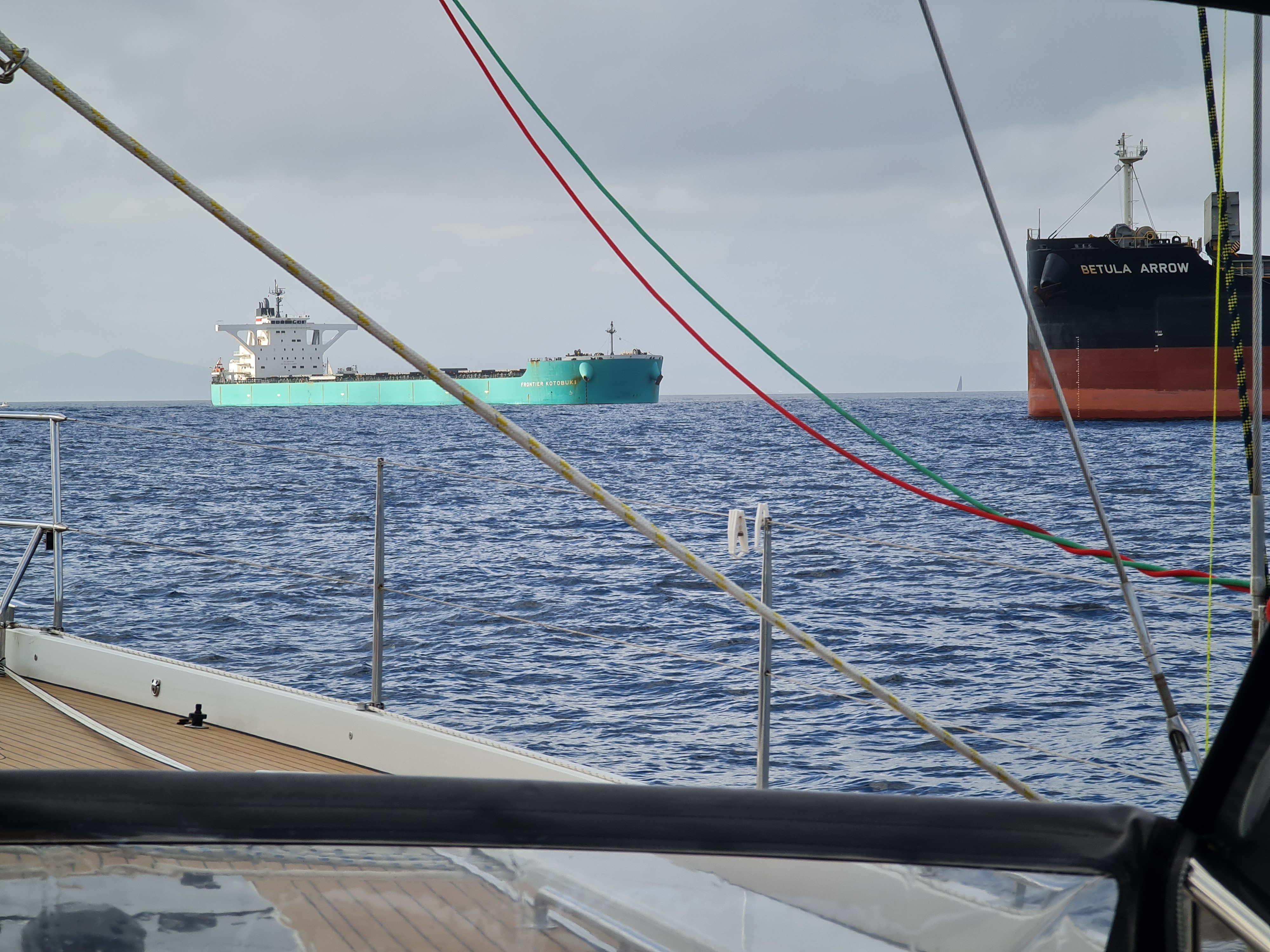
The practical reality of collision avoidance — or, what your sailing instructor did not have time to mention before lunch.
Disclaimer: This article is provided for educational and informational purposes only. It does not constitute legal, maritime, or professional navigation advice. The International Regulations for Preventing Collisions at Sea (COLREGs) are complex regulations that vary in implementation across jurisdictions. This content is a simplified overview and does not replace the full text of the regulations, official IMO publications, national maritime legislation, or professional training.
The Teacher
A reputable offshore sailing school in France. The kind where they take the theory seriously before they let you anywhere near the ocean. The instructor had just spent two hours walking through the COLREGs — Rules 2 through 19, the hierarchy, the stand-on/give-way framework, the whole system we covered in Part 1. The slides were thorough. The diagrams were clear. The students were confident.
Then he closed the slides.
He looked everyone in the eyes, one by one, and said:
“Now forget all of that. Let me tell you about a tanker.”
What followed was not a collision story. It was not a tale of heroism or tragedy. It was arithmetic. Cold, patient, unanswerable arithmetic. And by the time he was done, nobody in the room felt confident about anything.
Here is what he said.
The Tanker Problem
Step 1: How tall is it?
Take a VLCC — a Very Large Crude Carrier. The kind you see in the Strait of Gibraltar, the English Channel, the Malacca Strait. Loaded, she displaces around 320,000 tonnes and draws about 21 metres. Her freeboard — the height of the hull above the waterline — is about 9 metres.
Now empty her. Send her back in ballast to pick up another load. Her draft drops to about 8 metres. Her freeboard rises to over 20 metres. The bow is now a steel cliff, seven storeys above the water. Your hull, on a 42-foot sailing yacht, sits about 1.5 metres above the waterline. Your mast is 19 metres tall, yes — but a thin aluminium tube against the sky is invisible from a mile away. What matters is the hull. The thing that will actually hit the thing. And that is a white sliver, one and a half metres high, against a white-capped sea.
The tanker’s bow is thirteen times taller than your entire visible profile.
Step 2: What can she see?
The bridge on a VLCC is at the stern. It is about 300 metres from the bow. In ballast, the bridge officer’s eyes are roughly 55 metres above the waterline. That is the 17th floor. Imagine looking down from a party on the 17th floor, trying to spot a kayak in the car park.
Now do the geometry. The officer is looking forward from 55 metres high, over a bow that rises 22 metres above the water, 300 metres ahead. The line of sight just clearing the top of the bow hits the sea surface approximately 200 metres beyond the bow.
That means there is a blind zone — a cone of complete invisibility — extending over 500 metres ahead of the vessel where the bridge officer cannot see the surface of the water at all. Not with binoculars. Not with concentration. Not with perfect eyesight and the best of intentions. The bow is in the way. The physics of light does not negotiate.
Your 12-metre yacht, sitting 2 metres above the waterline, is in that cone. You are invisible. Not metaphorically. Geometrically.
And it gets worse. As we discussed in The 360-Degree Lookout Problem: Why Slow Boats Face Danger from All Directions, the faster a vessel goes, the more her collision threats concentrate forward of the beam. She is faster than you. Which means you are, most of the time, right in the dead zone — ahead of her, where she cannot see you and where her collisions are most likely to happen.
SOLAS Chapter V, Regulation 22 acknowledges this. The regulation permits a blind zone of up to 500 metres or two ship lengths, whichever is less. This is not a failure of compliance. It is a feature of the design. The ship is allowed to not see you.
Step 3: How heavy is it?
A loaded VLCC displaces approximately 320,000 tonnes. To put that in perspective:
- A Boeing 747 weighs about 440 tonnes at maximum takeoff weight. The tanker weighs as much as 727 fully loaded 747s.
- An aircraft carrier — the USS Gerald Ford — displaces about 100,000 tonnes. The tanker is three aircraft carriers.
- Your 42-foot yacht displaces about 10 tonnes. The tanker outweighs you 32,000 to one. Your insurance company calls this a “total loss.” The tanker’s insurance company calls this “Tuesday.”
Water does not have brakes. But it does have inertia. When you push 320,000 tonnes of steel through the ocean at 15 knots, the water moving with the hull — the hydrodynamic added mass — increases the effective mass by about 5 to 10 percent. You are now trying to stop 340,000 tonnes.
The kinetic energy of this mass at 15 knots (7.7 metres per second) is:
½ × 340,000,000 kg × (7.7 m/s)² ≈ 10 gigajoules
That is roughly 2.4 tonnes of TNT. Moving at you, in silence, at the speed of a bicycle.
Step 4: How long does it take to stop?
If the bridge orders a crash stop — full ahead to full astern, the most extreme emergency manoeuvre available — the vessel will travel between 2 and 3 nautical miles before it comes to rest. This takes 15 to 20 minutes.
Two to three nautical miles. At the moment they see you — if they see you — they need three miles of open water behind you in which to stop. If you are one mile ahead and they initiate an emergency stop this instant, they will pass through your position in approximately four minutes, still doing ten knots.
But that assumes they order a crash stop the moment they see you. It assumes someone is looking. It assumes the engine is ready. It assumes the captain decides, in the space of a few seconds, that your yacht is worth the mechanical stress of a crash stop on a two-stroke marine diesel that costs more than your house.
And without engine action? Without anyone touching anything? Coasting on inertia alone, the ship will travel 5 nautical miles or more before friction and drag bring her to rest. Half an hour. You will have long since become a debris field.
Step 5: How long does it take to wake the engineer?
On many large commercial vessels operating under Unmanned Machinery Space (UMS) protocols, the engine room is unmanned at night. The bridge has direct engine control, but significant changes to engine speed — the kind needed for an emergency manoeuvre — may require an engineer.
The engineer is asleep. In a cabin. Behind a fire door. Down a corridor. On a vessel that vibrates constantly, producing a background hum that masks all but the most persistent alarms.
From the moment the bridge calls the engine room to the moment a qualified engineer reaches the controls and confirms readiness: 5 to 15 minutes. On a good night. With a responsive crew. On a well-run vessel.
In 5 minutes at 15 knots, the tanker travels 1.25 nautical miles. In 15 minutes, 3.75 nautical miles.
You needed those minutes three miles ago.
Step 6: How much does it cost them to avoid you?
A VLCC burns approximately 80 to 100 tonnes of fuel per day at service speed. VLSFO — very low sulphur fuel oil — costs around €550 per tonne. That is €44,000 to €55,000 per day in fuel alone.
Now ask the captain to slow down by 2 knots to let you pass.
A large two-stroke marine diesel does not change speed the way your car does. You do not press a pedal. You initiate a sequence. The bridge orders a reduction. The engine management system begins decreasing RPM. The massive flywheel — several tonnes of rotating steel — resists the change. Thermal stresses shift across the cylinder liners. The turbocharger adjusts. The entire process takes minutes, not seconds.
Then you pass. Then they need to re-accelerate. The same sequence, in reverse. More thermal cycling. More mechanical stress on an engine that costs more than most people’s lifetime earnings. Each speed change is a wear event on components that are measured in tens of thousands of running hours.
The fuel cost of the manoeuvre itself is modest — perhaps €200 to €300 in savings during the 15 to 20 minutes at reduced speed, immediately consumed again during re-acceleration. But the schedule cost is not trivial: a VLCC’s operating cost is €3,300 to €5,000 per hour. Twenty minutes of disruption costs the operator €1,100 to €1,700. The mechanical stress on the engine is unquantifiable but cumulative.
And that is for one yacht. In the Strait of Gibraltar, they might encounter a dozen in a single watch. Nobody is cycling a 50,000-horsepower diesel up and down twelve times per shift for your right of way.
Step 7: Can they see you on radar?
You might assume that even if the bridge officer cannot see you with his eyes, the radar will pick you up. After all, radar is one of the “all available means” in Rule 5, and the tanker has a state-of-the-art X-band and S-band installation worth more than your yacht.
The radar cross-section of a 12-metre fibreglass yacht with an aluminium mast is between 1 and 5 square metres. For context, a large seabird returns about 0.5 square metres. You are, to a commercial marine radar, approximately two seagulls rafting together.
In calm seas, with perfect radar calibration and an attentive officer, you might appear as a faint blip. In 2-metre seas — ordinary conditions in the Mediterranean in summer — the sea clutter will swallow you whole. Your blip will appear and disappear between wave returns. The officer will see it, lose it, see it again, and classify it as noise. Because that is exactly what it looks like.
There are dedicated radar reflectors designed for pleasure boats. The ARC — the Atlantic Rally for Cruisers — requires them, and for good reason: the rally organisers have crossed enough oceans to know that a GRP hull in open water is as visible on radar as your cat crouched behind a flowerpot waiting for a mouse. The cat is absolutely certain it is invisible. The cat is correct. But you are not the cat. You are too proud of your 50-foot investment — the investment of your life, the thing you mortgaged your house for — to believe you are invisible. It is big. It is expensive. It has a name on the stern and a flag on the backstay. It cannot possibly be invisible. And yet it is. The radar does not care what you paid for it. And most cruising yachts do not even carry a proper radar reflector. And the cheap ones sold in chandleries — the octahedral aluminium things that rattle in the rigging — often have an effective radar cross-section measured in optimism rather than square metres.
Step 8: Can you attract their attention?
Your horn. The small, compressed-air canister mounted on a bracket somewhere near the companionway. It produces about 120 decibels at one metre. Sound attenuates with distance. By one nautical mile, your horn is a whisper against the wind. Remember the party on the 17th floor? Try shouting at it from the car park.
The bridge of a VLCC is enclosed. Air-conditioned. The windows may be closed. The ambient noise from the engine, transmitted through the hull, is 75 to 85 decibels. The officer on watch may be monitoring the radar. He may be completing paperwork. He may be making coffee. He may be doing exactly what Rule 5 requires — maintaining a proper lookout — and still not hear your horn at any range that matters.
The VHF then. Channel 16. You key the mic and call:
“Large tanker northbound off Cap Corse, this is sailing vessel…”
Which large tanker? There are six on the AIS. Does the officer know his own vessel’s name? (Yes.) Does he know you are talking to him? (Probably not.) Is he listening to channel 16? (Regulations say he should be. Reality says the volume is low and the squelch is high.) Will he respond in time to change anything? The tanker needs 15 minutes and 3 miles to stop. Your VHF call, even if heard, even if understood, even if acted upon immediately, changes nothing about the physics.
And if he does answer? Best case. He keys the mic and says:
“Sailing vessel, confirm port to port.”
That is not an offer to manoeuvre. That is a confirmation that he will maintain course and speed, and that you — as the competent, Rule 2-compliant skipper he assumes you are — will alter to pass on his port side. And he is right. That is exactly what you should do. Port to port means he does not move. You move. You were always going to move. The VHF call just made it official. Congratulations. You have used the radio to formally agree to do what you should have done ten minutes ago.
Step 9: How much does it cost to deviate?
Suppose the officer sees you — a miracle of attention, geometry, and luck. Suppose he decides to alter course by 20 degrees to pass clear. At 15 knots, deviating for 10 minutes to clear your position adds approximately 0.3 nautical miles to the voyage. The extra fuel: about €50. The extra time: about 90 seconds.
That sounds trivial. And it is, for one yacht. But the Strait of Gibraltar sees over 300 commercial vessel transits per day. The English Channel, over 500. Twelve yacht encounters per watch, four watches per transit, 90 seconds each — that is 72 minutes of accumulated delay per passage. Seventy-two minutes that push the arrival past the pilot window. Seventy-two minutes that the charterer will notice. Seventy-two minutes that come out of the captain’s on-time arrival bonus and the chief officer’s performance review.
And every course deviation means a call to the engine room. Every call to the engine room means the third engineer — who just fell asleep forty minutes ago after a six-hour watch — gets woken up, pulls on his boiler suit, walks down two decks, confirms the manoeuvre, stands by for ten minutes, then walks back up to his cabin, lies down, stares at the ceiling, and tries to fall asleep again before the next yacht appears on the radar. If it appears on the radar. He is not thinking kind thoughts about recreational sailing.
Nobody on that vessel is motivated to find you. The captain loses his bonus. The officer loses his clean watch record. The engineer loses his sleep. And you lose your boat. The incentive structure is not in your favour.
The Punchline
The teacher let the silence settle. Then he said:
“Now here is the thing. That tanker is not breaking any rules.”
He let that land.
The officer on watch is doing his job. He is on the bridge. The radar is on. He is scanning. He is complying with Rule 5 — maintaining a proper lookout by all available means. He is proceeding at a safe speed for a vessel of that size and draft, in full compliance with Rule 6. He is aware, professionally and personally, that invisible yachts exist somewhere out there in the sea clutter. He is doing everything right.
And he still cannot see you.
He is respecting the COLREGs. Perfectly. And the COLREGs — Rule 2, the rule that overrides all others — say that you have the duty to exercise good seamanship. You have the duty to avoid a collision that will sink you without a trace and leave the tanker without a scratch on the paint. A collision that the bridge may not even notice until someone spots a dent during the next dry dock inspection. A collision that will be investigated, documented, and filed — listing your failure to keep clear as the primary cause.
“So when you see a tanker — any tanker, anywhere, in any conditions — what are you going to do?”
The answer was unanimous, immediate, and did not require a diagram.
Get out of the way.
Rule 2, Revisited
And this is where Part 1 and Part 2 meet. Rule 2 — Responsibility — says that nothing in the COLREGs shall exonerate any vessel from the neglect of any precaution required by the ordinary practice of good seamanship.
Good seamanship is not asserting your right of way against 320,000 tonnes of steel that cannot see you, cannot hear you, cannot stop for you, and has no economic incentive to try. Good seamanship is understanding that the rules describe a legal framework, not a physical one. The law says the tanker gives way. Physics says the tanker cannot. And when law and physics disagree, physics wins. Every time. Without exception. Without appeal.
The instructor understood this. The rules are important — you must know them, because a court will judge you by them. But the first rule of practical seamanship is older than the COLREGs, older than the IMO, older than the first iron ship:
Do not put yourself in a position where your survival depends on someone else’s competence, attention, or goodwill.
The tanker’s officer may be brilliant. He may be exhausted. He may be on his phone. You do not know, and you cannot know. What you can know is this: you are 10 tonnes in a world of 320,000 tonnes. You are 12 metres in a world of 330 metres. You are fragile, slow, invisible, and irrelevant to the economics of global trade.
Act accordingly.
Now Let’s Talk About You
We have spent nine steps examining the tanker. The officer who cannot see you, the engine that cannot stop, the economics that do not care. But the tanker, at least, has a professional crew. A watch schedule. A functioning radar. A bridge officer who, even if he cannot see your yacht, is trained, certified, and awake.
Now let us look at your side of this equation.
The Toilet Problem, Revisited
You are two on the boat. One is sleeping — legitimately, necessarily sleeping, because you have been standing four-hour watches for three days and a human being who does not sleep becomes a human being who cannot distinguish a cargo ship from a seagull at two miles. The other is on the helm.
The one on the helm needs the toilet.
Rule 5 says: at all times. We covered this in Part 1. The IMO did not include a bathroom exemption. But here you are, two hundred miles from land, and your bladder does not report to the IMO.
You can time it. You can scan the horizon, check the AIS, check the radar, confirm nothing is within 6 miles, and sprint below. Two minutes. Three if things are complicated. In those three minutes at a closing speed of 20 knots — your 6 and a tanker’s 15, converging — a vessel that was 6 miles away is now 5 miles away. Probably fine. Probably.
But “probably fine” is not what Rule 5 says. Rule 5 says at all times, by all available means. And your available means are currently trousers around your ankles in a fibreglass cupboard below the waterline.
Many experienced ocean sailors solve this pragmatically: they use the open-air heads — a bucket, the transom, or simply the leeward rail. It is not dignified. It is not in the brochure. But it keeps your eyes on the horizon. The ocean does not care about your dignity. It cares about your attention.
The Solo Sailor’s Impossible Mandate
Now make it worse. You are alone.
Solo sailors cross oceans. They race around the world. They are among the most skilled and experienced mariners alive. And every single one of them violates Rule 5 — continuously, systematically, and unavoidably — for the entire voyage.
You must sleep. A human being needs a minimum of four to six hours of sleep per day to remain functional. During those hours, nobody is keeping a lookout. The autopilot is steering. The AIS alarm may be set — if your system has one, if it works, if it is loud enough to wake you from the comatose sleep of a solo sailor on day twelve. The radar alarm may be set — if the sea clutter is not triggering false alarms every four minutes, which it probably is, which is why you turned it off on day three.
You must eat. You must cook. You must repair things — the broken block, the chafed line, the bilge pump that started making a noise. You must navigate. You must charge batteries. You must pump the bilge. Every one of these tasks takes you away from the lookout that Rule 5 demands at all times.
The “all available means” for a solo sailor is: eyes on the horizon when on deck, AIS and radar alarms when below, and a fervent hope that everyone else is paying more attention than you are. This is not what the rule envisions. This is not what a court would consider adequate. But it is the physical reality of single-handed sailing, and the thousands of solo sailors who cross oceans every year are living proof that the rule describes a legal ideal, not an operational possibility.
The Asymmetry of Consequences
And here is the part that should keep you awake — during the hours you have allocated for sleeping.
If a tanker hits you, you sink. Your yacht — 10 tonnes of fibreglass, aluminium, and everything you own — disintegrates against 320,000 tonnes of steel moving at 15 knots. The impact energy is absorbed entirely by your vessel. The tanker does not slow down. The hull plating does not dent. The officer on watch may feel a slight vibration. He may not.
If you do not have an EPIRB — an Emergency Position Indicating Radio Beacon, the device designed to scream your position to satellites the moment it hits water — nobody will know. No distress signal. No Mayday. No search. No rescue. Your boat becomes debris. The debris becomes flotsam. The flotsam sinks or disperses. Within days, there is no physical evidence that you existed.
The tanker arrives in port on schedule. The hull is inspected during the next dry dock, months later. Perhaps someone notices a scratch. Perhaps not. Your collision goes unrecorded. Your disappearance becomes a mystery — a yacht that “failed to arrive,” a family that waits, a coast guard search that finds nothing because there is nothing to find.
This is not dramatic fiction. This is the documented reality of several disappearances per year. Yachts that vanish mid-ocean, never found, never explained. Some are weather. Some are structural failure. Some are collisions with shipping that the ship never detected and the yacht never survived long enough to report.
The COLREG system assigns responsibilities. It defines who gives way and who stands on. It is a fair system, a logical system, a well-designed system. But it is a system that assumes both parties are aware of each other’s existence. When one party is invisible, inaudible, and undetectable — and the other party is made of steel, displaces a third of a million tonnes, and has the kinetic energy of a small bomb — the system’s fairness is academic.
You are the loser in this equation. Always. Without exception. The tanker goes home. You do not. And no amount of right-of-way, no amount of legal correctness, no amount of posthumous vindication in an admiralty court will change that arithmetic.
Carry an EPIRB. Keep a lookout. And get out of the way.
Decision Fatigue, or: Why I Start the Engine
I will admit something. I have sailed enough miles to know the COLREGs. I wrote Part 1 of this article. I can explain Rule 17’s three phases at a dinner party. And yet, at two in the morning, on watch, tired, cold, with a vessel approaching on the port bow under sail — I cannot reliably calculate Rule 12.
Wind on the port side or the starboard side? His or mine? Are we on the same tack? Who is to windward? Is he actually sailing or is that a riding sail and he is motor-sailing? If he is motor-sailing, Rule 12 does not apply and we are in Rule 15 territory. But I cannot tell from here. Rule 12 is the only rule in maritime law that requires you to know trigonometry while seasick. And I am tired. And the coffee is cold. And the other crew is asleep and I will not wake them for a geometry problem.
And if I smell a collision risk — anything that makes the hair on the back of my neck stand up — I turn 30 degrees. Immediately. Before thinking. Before classifying the encounter. Before deciding who has right of way. Thirty degrees to starboard costs me less time than googling “COLREG Rule 5” or asking ChatGPT who has priority. By the time the chatbot has finished its disclaimer, I have already passed clear.
So I start the engine.
Not to go anywhere. Not to charge the batteries — although that is what I tell myself. I start the engine because the moment I do, I am a power-driven vessel, and so is everyone else who is not flying a sail in the pure and virtuous sense that Rule 12 demands. And power-driven vessels have simpler rules. Vessel on your starboard? You give way. Head on? Both turn right. Overtaking? Overtaker keeps clear. No wind-side calculations. No tack assessment. No philosophical debate about whether the other vessel’s asymmetric spinnaker counts as “sailing.”
This is not seamanship. This is cognitive self-defence. And I suspect every honest sailor who has done night watches on a passage has done exactly the same thing.
The Problem With Seventeen Rules at 3 AM
The COLREGs are a masterpiece of regulatory design. They cover every conceivable encounter type with logical precision. But they were designed to be applied by trained, rested, professional mariners on structured bridge watches — not by a couple on a 42-foot yacht splitting the night into three-hour shifts, one of whom is on day four of a passage and has averaged five hours of broken sleep per night.
Fatigue does not just make you slower. It degrades the specific cognitive functions that collision avoidance demands:
- Classification — is this a crossing, head-on, or overtaking situation? The geometry requires mental rotation, bearing assessment, and an understanding of the other vessel’s aspect. At 3 AM, all vessels look the same: like lights.
- Rule selection — are we both sailing? Is one of us motor-sailing? Are we in a narrow channel? A TSS? The answer changes which rules apply. Getting it wrong means applying the wrong framework entirely.
- Risk assessment — is the bearing changing? Is the CPA adequate? This requires sustained attention to a slowly evolving situation, which is precisely the cognitive task that fatigue destroys first.
- Action decision — how much do I turn? Which way? Will this create a new conflict with the vessel behind the first one? Multi-target scenarios require working memory that a fatigued brain simply does not have.
- Monitoring — after you act, you must verify the result. This means maintaining attention on a situation you have already mentally filed as “dealt with.” Fatigue makes this nearly impossible.
Each of these steps is straightforward at noon, with a full crew, after a good breakfast. At 3 AM, on a rolling deck, after four hours of staring at darkness, the entire chain collapses. You default to instinct. And instinct, without a framework, is just guessing.
A Simplified Decision Framework
So here is what actually works when you are too tired to think in seventeen rules. A decision tree that fits on an index card. It does not replace the COLREGs — nothing does — but it reduces the cognitive load to something a fatigued brain can handle.
Step 0: Look properly, at intervals.
Rule 5 says “at all times.” Reality says that staring at the horizon and the screens in a comatose state for four hours produces a human being who cannot distinguish a tanker from a cloud. I prefer to inspect the traffic thoroughly at regular intervals — a proper, disciplined scan of the horizon, the AIS, and the radar, every ten to fifteen minutes. Eyes engaged. Brain on. Then back to whatever keeps me functional between scans.
This works. But it demands discipline on timing. The interval depends on where you are — oceanic, offshore, coastal, a TSS, a narrow channel. In open ocean with no traffic on the AIS, the timeout is generous. In the Strait of Messina on a summer afternoon, it is measured in seconds. No interval should ever stretch beyond what the conditions and the zone demand. The gap between scans is the gap in which the tanker you did not see gets to meet the yacht you are still paying for. Keep it appropriate. Keep it regular. And if something appears, stay on it until it is resolved.
Step 1: Is there a vessel?
Look. Check the AIS. Check the radar. If there is a vessel within 6 miles and the bearing is not changing, you have a problem. If you are not sure, assume you have a problem.
Step 2: Is it big?
If it is a commercial vessel — cargo, tanker, ferry, anything with “commercial” in its AIS class — get out of the way. Period. Do not calculate who has right of way. Do not consult Rule 18. Do not think. Just move. You do not debate right of way with a bus while crossing the street. A tanker is a bus that cannot brake and whose driver may be asleep. The asymmetry of consequences makes this the only rational decision regardless of what the rules say. Rule 2 agrees with you.
Step 3: What type of encounter?
Three possibilities. Only three. Forget the sub-categories.
| If the vessel is… | It is a… | You do… |
|---|---|---|
| Coming toward you, roughly head-on | Head-on | Turn starboard. Both of you. Always. |
| On your starboard side, crossing | Give-way crossing | Turn starboard, pass behind them. |
| On your port side, crossing | Stand-on crossing | Hold your course. But watch them. If they do not move, you move. |
| Coming from behind you | Overtaking | They keep clear. Hold your course. |
| You are coming up behind them | You are overtaking | You keep clear. Go around. |
Step 4: Act boldly.
Whatever you do, make it big. Thirty degrees minimum. The other vessel needs to see your manoeuvre on their radar or by eye. Five degrees is invisible. Five degrees is a suggestion. Thirty degrees is a statement.
Step 5: Verify.
After you turn, check: is the bearing changing now? Is the CPA opening? If yes, maintain your new course until the vessel is past and clear. If no, turn more. Or slow down. Or stop. Do not sit there hoping the geometry will sort itself out. It will not.
The Index Card
If you print nothing else from this article, print this:
Collision Avoidance — Simplified
| 1. | COMMERCIAL VESSEL? | GET OUT OF THE WAY |
| 2. | HEAD-ON? | TURN STARBOARD |
| 3. | ON YOUR STARBOARD? (turn starboard, pass astern) |
YOU GIVE WAY |
| 4. | ON YOUR PORT? (but be ready to move if they don’t) |
HOLD COURSE |
| 5. | OVERTAKING THEM? | YOU KEEP CLEAR |
| 6. | THEY OVERTAKING YOU? | HOLD COURSE |
This is not a replacement for the rules. A court will still judge you by the full COLREGs. But a court would rather judge a living skipper who made a pragmatic decision at 3 AM than write the conclusion to a disappearance report. Nobody has ever been convicted of being too cautious. Plenty have been convicted of being too confident.
The COLREGs are seventeen rules. They are logical. They are complete. They are correct. And they are useless if you are too tired to apply them. The best collision avoidance system ever designed is a rested crew. The second best is a simple framework that a tired crew can actually use.
Be the second best. It beats being a debris field.
Legal Notice:
- The information in this article is based on the Convention on the International Regulations for Preventing Collisions at Sea, 1972 (as amended). National implementations may differ. Always consult the applicable regulations in your operating jurisdiction.
- Nothing in this article shall be construed as an authoritative interpretation of any COLREG rule. For definitive interpretations, consult your national maritime authority, a qualified maritime lawyer, or the IMO.
- Products by Galvanic Works SL are decision-support tools, not certified navigation aids or collision avoidance systems. Safe navigation remains the sole responsibility of the vessel’s master.
- No liability is accepted by Galvanic Works SL, its directors, employees, or affiliates for any loss, damage, injury, or death arising from the use of or reliance on the information in this article.
- All sailors are encouraged to complete a recognised maritime safety course (e.g., RYA, US Sailing, World Sailing) covering COLREGs and collision avoidance.
© 2026 Galvanic Works SL. All rights reserved.

Leave a Reply