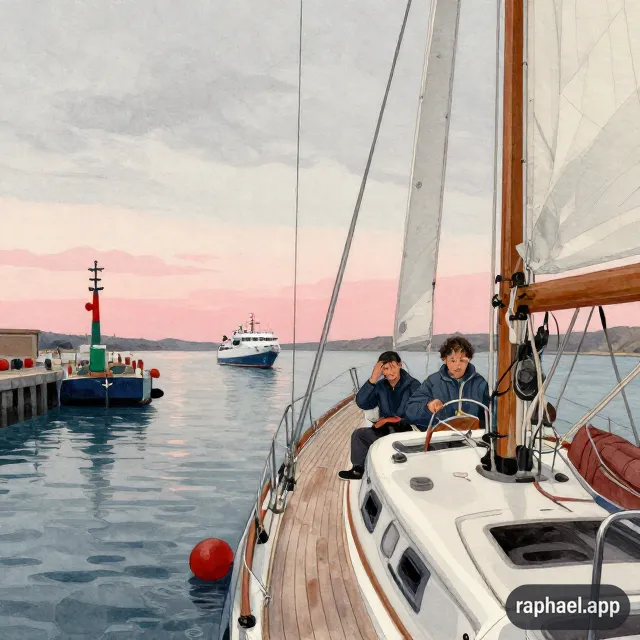
One passage. 36 hours. Five chapters. Five sailor types — find yours.
5 chapters21 questions~5 minutes
Iron WatchStrategic NapperDangerous OptimistHarbour HuggerWalking Dead
ⓘ How we use your answers
Before you cast off
This research survey by Galvanic Works S.L. looks at how recreational sailors actually cope with sleep debt on multi-day passages. Your anonymous chapter answers feed into research on maritime fatigue (preprint: DOI 10.20944/preprints202603.1014.v2). We also build and sell maritime safety products — if you give us your email at the end, you may opt in to hear about them.
Legal basis: legitimate interest (research) for anonymous chapter data; consent (Art. 6(1)(a) GDPR) for any email provided. Retention: 24 months. Data controller: Galvanic Works S.L. Privacy Policy.
By continuing, you confirm you are 18 or older.
Chapter 1
Hour Zero — The Plan
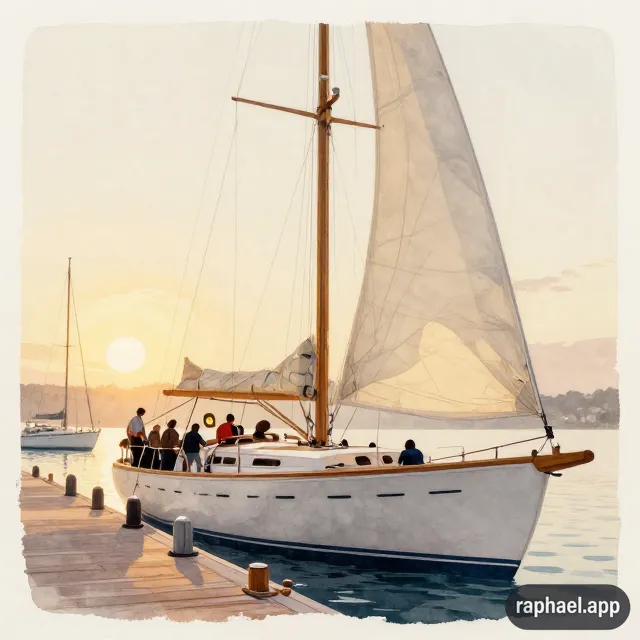
The passage plan says 36 hours. The weather window opens at 0600. You've been at the nav station since 0430, running the numbers one more time. Tides, waypoints, fuel calc. The crew arrives in stages — one is already asleep in the saloon, one is making coffee that's too strong for this early, one hasn't arrived yet and isn't answering their phone. The forecast is good. The boat is ready. You are optimistic. You are also already slightly tired, because you were up until midnight checking the forecast that you already checked at eight. But today is departure day, and departure day runs on adrenaline. Adrenaline is not a watch system.
Question 1
First things first — how long have you been doing this?
Please select an answer to continue.
Question 2
Your longest passage in the last three years?
Please select an answer to continue.
Question 3
How many people are usually aboard on passage?
Please select an answer to continue.
Question 4
What's your primary role on passage?
Please select an answer to continue.
Chapter 2
Hour Six — The Routine
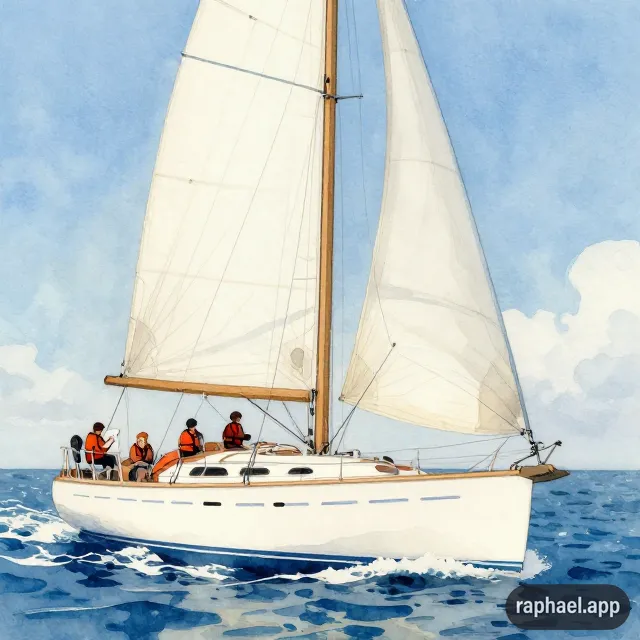
Six hours out. The boat has found its rhythm. The autopilot is on. The genoa is set. Someone is heating soup they made yesterday, and it smells better than it has any right to at noon on a Tuesday. The watch system — such as it is — has started. The skipper explained it before departure, on a piece of paper that's already in the chart table under two mugs and a tide table. Three hours on, three off. Or was it four and four? The paper said three. The person now on watch thinks they heard four. This will not be resolved until 0200, when it will be resolved badly.
Question 5
Do you use a formal watch system on passage?
Please select an answer to continue.
Question 6
When you do run watches, how long are they?
Please select an answer to continue.
The Royal Navy has spent centuries perfecting watch rotations. The merchant fleet has IMO regulations, mandatory rest periods, and officers whose entire job is fatigue management. You have a piece of paper and optimism. The paper system breaks down within twelve hours of departure — usually at the first sail change, when the off-watch crew gets called on deck "just for a minute" and then stands there for forty-five. The science on watch rotation is clear: fixed, short watches with protected sleep periods produce the best outcomes. The science on what sailing couples actually do is also clear: one person stays up until they can't, then the other one takes over. It's called the "I'll just keep going" system, and it has a failure mode.
Question 7
How strictly do you actually stick to the rotation?
Please select an answer to continue.
Question 8
Do you plan watch schedules before departure?
Please select an answer to continue.
Chapter 3
Hour Twelve — The Drift
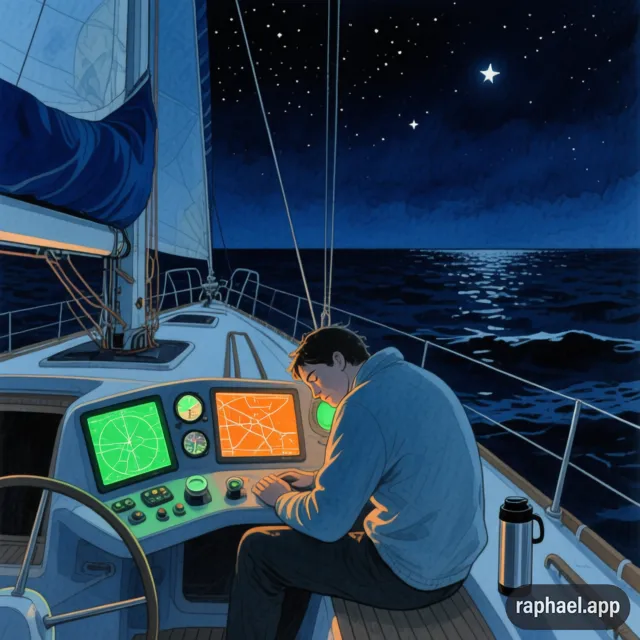
Midnight. You've been sailing for twelve hours. The adrenaline that carried you out of the harbour burned off somewhere around hour four, and since then you've been running on dinner and determination. The horizon is black. The instruments glow. The autopilot hums. Your eyelids are doing something involuntary — not closing exactly, but blinking longer than blinking should take. Three seconds. Five seconds. You open them and the compass has moved ten degrees. Or has it? You look at the chart plotter. The track is straight. Everything is fine. You blink again. Seven seconds this time. That wasn't a blink. That was a micro-sleep, and if you'd been standing at the helm of a ship, your company would be legally required to record it. You're standing at the helm of a yacht, so nobody records anything.
Question 9
On a multi-day passage, how many hours of actual sleep do you get in 24 hours?
Please select an answer to continue.
Question 10
Compared to sleeping at home, sleeping on passage is...
Please select an answer to continue.
The cabin of a yacht at sea is precisely engineered to prevent sleep. The angle of heel puts you against the leeboards. The motion is irregular enough that your vestibular system never quite adapts. The engine, if it's running, vibrates at a frequency that penetrates earplugs. The off-watch cabin is either too hot (tropics, closed hatches) or too cold (North Atlantic, open hatches because someone is being sick). And then there are the sounds — the ones you learn to filter, and the ones you don't. A sheet easing through a clutch: filtered. A new noise from the keel area: not filtered. Your brain is doing threat assessment in your sleep. It's impressive biology. It's terrible rest.
Question 11
What disrupts your sleep on passage?
Select all that apply
Please select at least one option.
Question 12
Where do you primarily sleep on passage?
Please select an answer to continue.
Here is the part nobody talks about at the dock: the transition. You come off watch at 0200, wired from four hours of staring at darkness. Your brain is simultaneously exhausted and hypervigilant. You go below. It's warm. The boat is moving. You lie down. And then you lie there, replaying every course alteration and every set of lights you identified, while your relief — who was asleep twenty minutes ago — is now on deck doing the same thing you were doing, and you are not asleep. You have ninety minutes before your next watch. Eighty-five now. Eighty. You are doing the maths instead of sleeping. The maths is not helping.
Question 13
After a night watch, how quickly can you fall asleep?
Please select an answer to continue.
Chapter 4
Hour Eighteen — The Wall
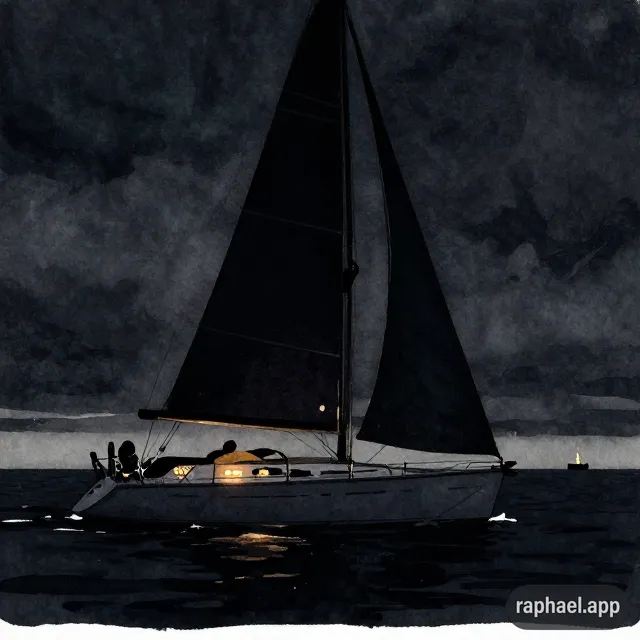
0300. The number that every passage sailor knows. The hour when the body's circadian trough meets the accumulated sleep debt and wins. You've been awake for — how long? You can't calculate it. That's the answer. You can't do the maths you could do at noon. The stars are out, or the clouds are low, and either way the sea looks the same in every direction, and you can't remember if the shipping lane is to port or starboard without checking the plotter. So you check the plotter. And then you check it again forty seconds later because you've already forgotten what it said. This is not tiredness. This is cognitive impairment. The research calls it "fatigue-related performance degradation." You call it Thursday.
Question 14
After 24 hours at sea with broken sleep, how would you rate your ability to make good decisions?
Be honest — this is anonymous
Please select an answer to continue.
Question 15
Have you ever caught yourself falling asleep — or "nodding off" — on watch?
Please select an answer to continue.
The MAIB — the UK's Marine Accident Investigation Branch — lists fatigue as a contributing factor in a significant proportion of recreational sailing incidents. Not the primary cause, usually. The primary cause is the thing you did wrong. Fatigue is the reason you did it wrong. You misread the chart. You didn't see the buoy. You tacked when you should have borne away. You made the kind of decision that, at noon, you would never make — and at 3AM, seemed perfectly reasonable. The incident report will say "failure of lookout" or "navigational error." It won't say "the skipper hadn't slept properly in 36 hours." But that's the sentence that explains all the others.
Question 16
Have you ever made a navigation or safety error that you attributed to tiredness?
Please select an answer to continue.
Question 17
During a passage, have you ever continued sailing when you felt you should have stopped and rested?
Please select an answer to continue.
Question 18
At your most tired point on a recent passage, how sleepy were you?
Karolinska Sleepiness Scale — widely used in fatigue research
Please select an answer to continue.
Chapter 5
Hour Twenty-Four Plus — The Reckoning
Dawn again. The same dawn as yesterday, but you are not the same sailor. Twenty-four hours of broken sleep, irregular meals, constant low-level vigilance, and one episode at 0300 that you're going to describe as "a bit drowsy" and will never describe as what it actually was. The coffee is on. The wind has eased. Landfall is four hours away, and the harbour approach involves a narrow channel, a cross-tide, and a ferry schedule. You are about to execute the most demanding piece of pilotage on the entire passage on the least sleep you've had in a year. This is the equation that nobody solves before departure. Everyone solves it on arrival. Some solve it badly.
Question 19
What do you use to manage fatigue on passage?
Select all that apply
Please select at least one option.
Question 20
If you could change ONE thing to manage fatigue better, what would it be?
Select up to 2
Please select at least one option (max 2).
Question 21
Want to see what other sailors said — and how you compare?
Please select an answer to continue.
Your email address
?
The 3AM Problem
Your fatigue profile is ready. Enter your email to unlock the full result — including your type, your boat, and your forum post. We'll also send you the research findings and what we're building to help manage fatigue at sea.