



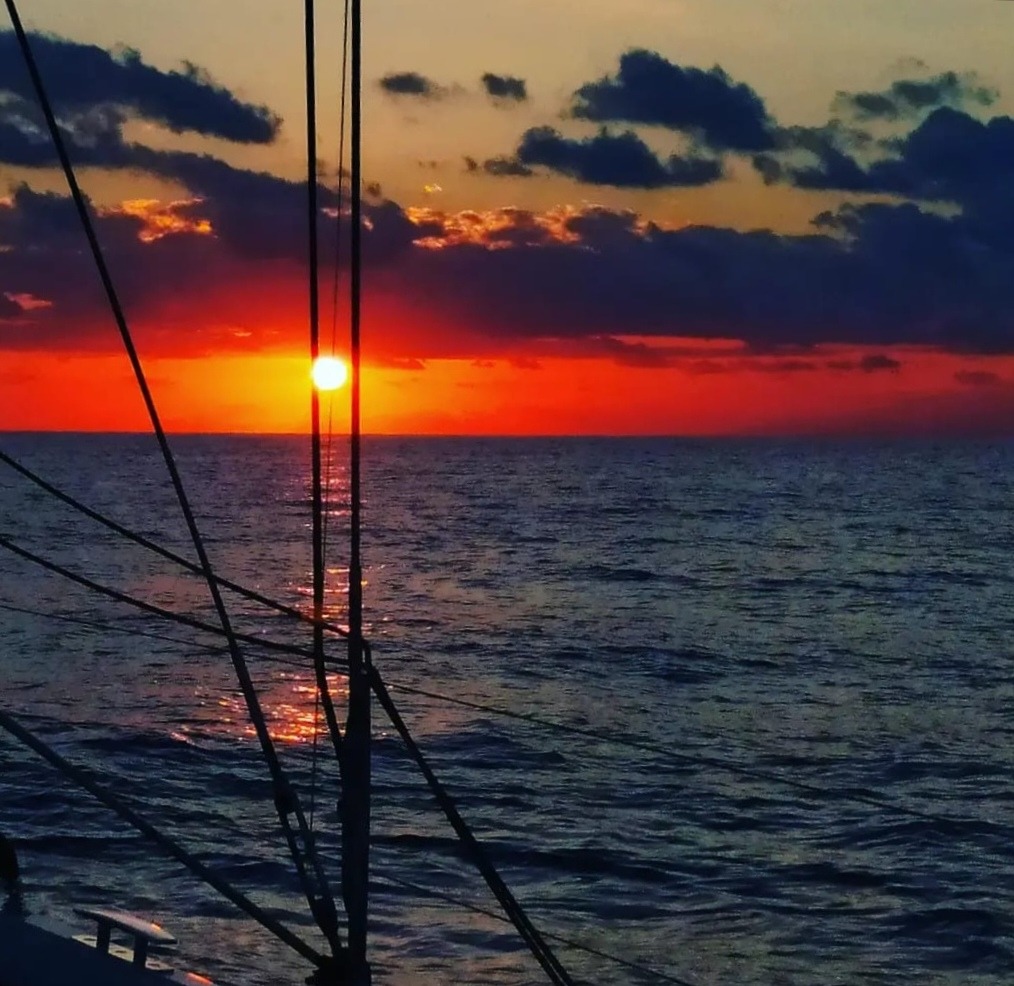
Departure: planned. Weather: studied. Fuel: topped up. Food: provisioned for a small war. Sleep: we’ll figure it out.
It is 0330. The wind has gone forward ten degrees and the autopilot has absorbed it without comment. Your watch-mate is below, probably asleep. You have been awake, more or less, for twenty-two hours. Your recollection of the last hour is a little soft around the edges, and if asked, you would describe yourself as “fine.”
You are, depending on which instrument you trust, fine or legally drunk. Nothing on the boat will tell you which.
Everyone budgets the passage. The route is plotted, the forecast compared across three models, the diesel calculated with a reserve, the crew briefed, the boat prepared to a standard that would embarrass a NASA engineer. And then, quietly, without ever being written down, the one resource that will determine whether the whole plan holds together is left entirely to improvisation.
Sleep is the only currency you cannot top up at sea. You start the passage with whatever balance you arrived with, spend it faster than you planned, and cannot borrow against the next port because the next port does not extend credit. The boat has a fuel gauge. The crew does not.
What follows is the story of that 0330 moment: what the science says is happening inside the skipper’s head, what experienced sailors actually do to keep it from going wrong, and why the gap between the two is smaller than you might hope.
The article below sits one level above the mathematics. It explains what the numbers mean for the person with a boat, a crew, and a weather window. The quantitative model is most reliable for passages of up to roughly 48 hours; beyond that, it extrapolates, and every multi-day claim below should be read as indicative rather than precisely calibrated.
What The Science Says (Briefly)
So: what is actually happening inside that skipper’s head at 0330? The research on sleep, fatigue, and circadian rhythm is neither new nor contested. It is, however, rarely read by the people it most concerns — which is to say, people on boats. Four findings do the heavy lifting.
One. Time awake. After 17 hours without sleep, cognitive performance is measurably equivalent to a blood alcohol concentration of 0.05% — the legal driving limit in most of Europe and the UK. After 24 hours, it matches 0.10%, well past legal intoxication in any jurisdiction [1]. This is not a metaphor. It is the same reaction-time test, the same subjects, the same numbers. Our imaginary skipper is at hour twenty-two. Had they consumed enough alcohol to reach the same level of impairment, nobody sensible would let them near the helm. They are, however, on the helm.
Two. The hour on the clock. Independent of everything else, the human body runs a circadian trough every 24 hours, roughly between 0200 and 0600. The UK Marine Accident Investigation Branch finds groundings cluster in exactly this window [2]. Impairment during the trough can be roughly double what the same sleep debt produces at 1500. 0330, in other words, is not a neutral minute of the rotation. It is the hour at which biology and sleep debt stop adding and start multiplying. The skipper, at the moment of our vignette, has found the worst minute of the passage so far to be making decisions in.
Three. The passages that go longer than planned. Chronic partial sleep restriction — the six hours a night that every two-crew rotation quietly promises — accumulates linearly for at least two weeks. There is no plateau. The landmark experiment was run at the University of Pennsylvania in 2003. The researchers took healthy adults, put them in a controlled sleep laboratory, and restricted them to four or six hours of sleep per night for two full weeks. Every morning they measured reaction time, working memory, and attention with the same short cognitive tests used to assess airline pilots and military personnel. Every morning they also asked the subjects, on a simple scale, how sleepy they felt. What emerged was the quiet scandal at the heart of sleep science. Objective performance degraded steadily, day after day, and did not level off; by day 14, the four-hour group was performing as badly as someone who had been kept awake for two full nights. Their own rating of their sleepiness, meanwhile, rose for a few days and then plateaued — the subjects, after the first week, reported feeling about as tired as they had felt on day three, even as their performance continued to collapse [3]. They did not adapt. They simply stopped noticing. The humans, as the researchers put it, were wrong about the humans.
Four. The bunk below is not a hotel room. The sleep you get at sea is not the sleep you get ashore. The first clinical polysomnography study conducted on the open ocean measured sleep efficiency at 78% — for every hour in the bunk, 47 minutes of actual sleep [4]. In a seaway, fragmented sleep restores roughly 55–60% of the cognitive capacity that an equivalent consolidated sleep would [5]. The worse the weather, the more capacity you need; the less, precisely, you can recover.
There is a distinction buried in all four of the findings above that is worth stating flatly, because almost nothing in the rest of this article makes sense without it. Feeling tired is a sensation. Being impaired is a measurement of what you can and cannot do. Everyone recognises the first — the heavy head, the stinging eyes, the quietly compulsive ordering of coffee. Almost nobody reliably recognises the second. The drunk driver, at least, suspects that driving is a mistake; the sailor on 22 hours without sleep generally concludes the problem is the chart. The brain being degraded is also the brain doing the assessing, which is structurally the same arrangement as a drunk conducting their own breathalyser test and finding the results very encouraging.
That is the budget. It is tighter than most passage plans admit.
A brief word on the objection from the marina bar. Every yacht club contains the Sunday sailor who will explain, usually unprompted and usually over the second drink, that a good coffee solves all of it. He is partially right. Caffeine does block the neurochemical that keeps the running ledger of sleep debt, and a strong espresso genuinely buys an hour or two of alertness. What it does not do is pay the ledger. The debt sits there compounding, and the caffeine has the diabolical habit of wearing off at the exact hour of the passage that requires judgement — usually somewhere between the first set of leading lights and the marina finger pontoon.
What Experienced Sailors Actually Do
What follows is not prescription. It is a curation — drawn from long threads on the cruising forums, from delivery skippers with five-figure mile counts, from solo sailors with more Atlantic crossings than shore addresses, and from the French offshore racing tradition that has spent thirty years treating sleep as an engineering problem rather than a character flaw.
The patterns below do not appear in textbooks. They appear, repeatedly, in the accounts of people who keep arriving.
Bank Sleep Before You Leave
The single most consistent piece of advice from experienced skippers, and also the single most ignored. The night before departure is not the night for final provisioning, one last dinner ashore, and a 0300 check of the anchor windlass. The night before departure is when the passage actually begins.
Extended sleep in the 48 hours before casting off creates a genuine protective buffer — the research calls it “sleep banking,” and the effect is measurable for several days into the passage [6]. The skippers who treat this seriously arrive at the dock rested. The skippers who don’t arrive at the dock intending to catch up on the first off-watch, which, as the Pennsylvania researchers demonstrated, is roughly as realistic as planning to repay your mortgage from Monopoly earnings.
Choose The Departure Hour, Not Just The Date
A departure date is a decision about weather. A departure hour is a decision about sleep.
Leave at 0700 on a passage to a destination 36 hours away, and your first circadian trough (0200–0600 on night one) arrives somewhere around hour 19–23 of continuous wakefulness. This is the worst possible alignment. The biological dip and the sleep debt are at their maximum simultaneously.
Leave at 1500 and the numbers change. The first trough still arrives — biology is not negotiable — but now it lands on the second crew member, who left the dock mid-afternoon and has been off-watch since the first rotation. The captain, who took the opening shift, is in the bunk by midnight. Nobody is fresh; everybody is less tired than they would otherwise have been.
The departure hour is not cosmetic. On a short passage it is the single most powerful lever the skipper has over cumulative fatigue.
The Watch System Is A Budget, Not A Tradition
The 6-on/6-off has a satisfying symmetry that appeals to the part of the brain that also folds fitted sheets. It also, consistently, produces the worst fatigue outcomes in the research [7] — a result the research has been quietly repeating for thirty years without, somehow, reaching the chandleries. Six hours is long enough to build meaningful sleep debt on watch and short enough, after transits and meals, to leave barely four hours in the bunk below.
Shorter rotations — 3-on/3-off, or the classic Swedish 4/4/5/6/5 — cap continuous wakefulness and preserve the possibility of a single complete 90-minute sleep cycle per off-watch. Off-watch blocks shorter than about two hours yield almost no restorative sleep at all; the body barely crosses the threshold into deep sleep before the next call [8].
The Swedish pattern deserves a sentence of explanation, because it is not obvious on first inspection. The 24-hour day is cut into five unequal slots — 4, 4, 5, 6, 5 hours — and two crew alternate round-robin down the list. Because five slots divided between two crew does not divide evenly, each crew takes a different slot at the same clock hour on consecutive days. Whichever crew stood the 02:00 block last night stands a different block tonight. The uneven slot lengths are not a quirk; they are the mechanism by which the worst hour of the day is shared rather than assigned.
Then there is the longer end of the spectrum — and this is the part the textbooks rarely discuss.
A five-hour watch, unfashionable on paper, has quiet advocates among long-haul cruisers. The logic is that two full sleep cycles fit inside five hours off, with a margin for getting below, warming up, and falling asleep. You stand a slightly longer watch, you pay for it with one heavier circadian hit per rotation, and you collect in return something increasingly rare at sea: actual sleep. Note that 5-on/5-off does not tile a 24-hour day on two crew; the clock-anchor drifts, so the 02:00 slot lands on a different watchkeeper each night — which is either a feature or a complication, depending on who you ask. The trade-off is not obvious, and it does not suit every boat. On a passage long enough for day-three sleep debt to matter, it suits some.
A softer version of the same distributional trap appears on boats with an obvious asymmetry between the two crew — one experienced skipper and one less practised partner, or one seasoned sailor and a visiting friend. The temptation is intuitive, and it is almost always wrong: give the weaker hand the comfortable daytime watches and let the stronger absorb the difficult night hours. It feels generous. In practice, it quietly guarantees that when the real situation arrives — the gear failure at 0330, the ship on a collision course in poor visibility, the unexpected front — the only person on board capable of handling it is also the most fatigued one on board. The strong crew member’s value to the passage is precisely their capacity to function when things go wrong. Trading that capacity for domestic politeness on day two is, on day four, an expensive mistake. Share the difficult hours; protect the strong crew’s reserves for the moment the passage will actually need them.
None of these systems is correct. The correct system is the one that matches the crew, the boat, the passage length, and the expected sea state. The wrong system is the one inherited from a sailing school syllabus and never re-examined.
The Lazy Morning
One of the most pragmatic strategies shared by long-distance single-handers — and largely absent from the watchkeeping literature — is the deliberate protection of the morning.
The dawn watch is the most dangerous one. The circadian trough has done its work, sleep debt has accumulated through the night, and the slow brightening of the horizon carries the deceptive suggestion that the worst is over. It is not. Measured performance continues to decline for an hour or more after sunrise.
The strategy: rather than treat the post-dawn hours as the start of a productive day — repairs, cooking, sail changes — the experienced single-hander treats them as the end of the long night. Nothing demanding happens before 1000. The autopilot steers. The AIS watches. The kettle makes tea, possibly even without spilling any of it. The first real decisions of the day wait until the brain has booted back up. This is not laziness. It is the same principle that prevents you from letting a diesel engine take on full load in the first minute after a cold start — except the engine, in this case, is making the call on whether to gybe.
Add Crew
The most effective intervention for crew fatigue is, by a wide margin, the addition of one person. Going from two crew to three takes off-watch time from 50% to 67% of each 24-hour cycle. Across the research, the ratio of off-watch to on-watch time is the strongest single predictor of fatigue outcomes — stronger than watch length, stronger than sea state, stronger than everything except perhaps the departure hour [9].
The addition of a third crew member is not always possible. It is, however, always cheaper than the grounding the two-crew schedule was quietly arranging in the background. The boat insurance premium does not reflect this, on the theory that the insurance industry prefers claims to sleep research — a preference for which there is, regrettably, considerable evidence.
Weather Counts Twice
Every sailor knows that bad weather is harder. What fewer sailors articulate clearly is that bad weather taxes the fatigue budget twice — once on watch, once in the bunk.
On watch, in a seaway, the crew is not simply steering. They are bracing, wedging, holding on, drying off, re-reading the plotter because the last three attempts were interrupted by green water over the sprayhood. Cognitive load is elevated, thermal regulation costs energy, and fatigue accumulates faster than any watch schedule assumed when it was drawn up in calm weather on the chart table.
In the bunk, the same seaway steals the recovery. The off-watch crew rolls against the lee cloth, braces at every lurch, and crosses the threshold into deep sleep roughly as often as the boat crosses the Greenwich meridian. The model behind this article attributes roughly a 45% loss of sleep recovery to rough conditions, and closer to 70% in storm conditions [10]. Any offshore sailor pressed on the point will report figures in the same neighbourhood.
Two consequences follow. The first is that weather routing is a fatigue decision, not just a speed decision. A route six hours longer but with the seas on the quarter can arrive with a crew who has genuinely slept rather than endured. The fastest point on the plotter is often the slowest one on the dock, because the exhausted arrival crew takes twice as long to tie up, misreads the pilotage, and leaves the kettle on the stove.
The second is that a forecast showing 48 hours of Force 7 should quietly reset the passage plan before departure, not during. The watch schedule that works in a moderate breeze does not work in a gale, because the recovery it silently assumed is not happening. Some crews respond by accepting a later ETA; others respond by pretending the weather does not affect them, which is a strategy that works until, quite suddenly, it does not.
Routing software does not model crew fatigue. The skipper has to.
Day Three
Somewhere around the middle of day three, all of the above stops being theoretical.
The first 48 hours of a passage run on adrenaline, novelty, and whatever sleep was banked before departure. By hour 60 or so, all three of those accounts are empty. The fourth meal has been cooked. The watch system has settled. The first weather surprise has been absorbed. The hand-steering anecdote has already been told twice and is on its way to becoming a thing. The crew feels, on the whole, fine — possibly even faintly smug. Somewhere in the cockpit, a conversation about whether it might be time to take up ocean sailing properly has started to sound almost sensible.
This is the dangerous part.
The quantitative model behind this article is calibrated on passages up to 48 hours and extrapolates beyond; what it extrapolates is well-characterised in direction, if not in precise magnitude. What it says, and what the Pennsylvania researchers confirmed in detail, is this: self-rated sleepiness plateaus within a few days while objective performance keeps falling. The sailor on day three who reports feeling fine is not lying. They are simply using, to assess their own brain, the brain that is being assessed. It is not a reliable instrument, and it continues to report reliability with considerable confidence.
There is, at this point, an uncomfortable decision sitting at the chart table that nobody particularly wants to touch: ease the sheets, bear off ten degrees, accept the six-hour-later arrival, and let the off-watch crew sleep properly. The aggressive captain and the relâché captain — the two archetypes that define every sailing trajectory — both arrive at day three. Only one of them arrives rested enough to handle day four.
The Honest Part
None of this makes fatigue disappear. It does not exist to be defeated. It exists to be spent carefully.
The skippers who keep arriving, year after year, across oceans that rearrange themselves without warning, are not the ones who have conquered the need for sleep. They are the ones who have made peace with it. They bank it when they can, spend it when they must, and never — critically, never — make a major decision at 0400 on day three if it can wait until 1000.
Which brings us back to the skipper we left at 0330 — twenty-two hours awake, autopilot holding, kettle hissing, the word “fine” applied with a little less conviction than it deserves. They do not need to solve the problem from the helm. They need only to know the problem exists, and to have planned, somewhere earlier and more lucid, for the moment at which their own judgement stopped being the instrument they thought it was.
The passage will arrive when it arrives. The crew that arrives with it should, ideally, still be able to tie up to the dock without apologising for the boat hook.
References
- Dawson, D. & Reid, K. (1997). “Fatigue, alcohol and performance impairment.” Nature, 388(6639), 235.
- UK Marine Accident Investigation Branch (2004). Bridge watchkeeping safety study. MAIB, Southampton.
- Van Dongen, H.P.A., Maislin, G., Mullington, J.M. & Dinges, D.F. (2003). “The cumulative cost of additional wakefulness: dose-response effects on neurobehavioral functions and sleep physiology from chronic sleep restriction and total sleep deprivation.” Sleep, 26(2), 117–126.
- Bernd, K., Jentsch, H., Schildt, K., Oldenburg, M. & Jensen, H.J. (2023). “Sleep architecture and sleep-related breathing disorders of seafarers on board merchant ships: A polysomnographic pilot field study on the high seas.” International Journal of Environmental Research and Public Health, 20(4), 3168.
- Bonnet, M.H. & Arand, D.L. (2003). “Clinical effects of sleep fragmentation versus sleep deprivation.” Sleep Medicine Reviews, 7(4), 297–310.
- Rupp, T.L., Wesensten, N.J., Bliese, P.D. & Balkin, T.J. (2009). “Banking sleep: realization of benefits during subsequent sleep restriction and recovery.” Sleep, 32(3), 311–321.
- Härmä, M., Partinen, M., Repo, R., Sorsa, M. & Siivonen, P. (2008). “Effects of 6/6 and 4/8 watch systems on sleepiness among bridge officers.” Chronobiology International, 25(2–3), 413–423.
- Carskadon, M.A. & Dement, W.C. (2011). “Normal human sleep: an overview.” In Principles and Practice of Sleep Medicine (5th ed.), 16–26.
- Williamson, A. & Feyer, A.-M. (2000). “Moderate sleep deprivation produces impairments in cognitive and motor performance equivalent to legally prescribed levels of alcohol intoxication.” Occupational and Environmental Medicine, 57(10), 649–655.
- Wadsworth, E.J.K., Allen, P.H., Wellens, B.T., McNamara, R.L. & Smith, A.P. (2006). “Patterns of fatigue among seafarers during a tour of duty.” American Journal of Industrial Medicine, 49(10), 836–844.


Leave a Reply