
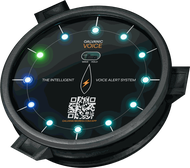




The first question every prospective customer asks us is some version of “I already have a chartplotter — why do I need this?” It is a reasonable question, and the answer is the subject of this piece. The short version: the Galvanic Voice is not a replacement for your multifunction display. It is the channel your multifunction display was never designed to be — the one that reaches the half of the boat that is not standing in front of the screen.
A modern multifunction display is one of the most impressive pieces of engineering on any cruising boat. It is also, structurally, unable to do most of the job we ask of it. Cruising sailing is not the America’s Cup. The vast majority of the hours we spend aboard are spent not staring at a chartplotter — they are spent cooking, sleeping, eating, reading, washing, dozing in the cockpit, watching the landscape go past. During those hours the MFD is either lit with nobody looking, or switched off entirely. An alert layer that only works when somebody is actively reading a screen is an alert layer that does not work for most of the hours of a cruising life.
What a Modern MFD Actually Does (Brilliantly)
Worth saying up front, because it is true. A modern marine multifunction display draws your chart, paints the radar on top of it, overlays AIS targets, fuses wind, depth, current and heel into a coherent picture, talks to the autopilot, plots a route, renders bathymetry under the keel, and warns you when you cross a contour line — all on one bright glass screen, with sub-second response, in daylight, in rain, with gloves on. Every cruising sailor who has used a current-generation chartplotter has had the experience of being genuinely impressed by what twenty years of marine-electronics development has produced. So have we. We use one ourselves.
We are not here to replace it.
But the MFD Has One Structural Blind Spot
The MFD does everything visually. It is a display — the D in the name does the work. A display only reaches a sailor who is actively looking at it. And on a real cruising boat, that is rare.
Take a sailor with 20,000 nautical miles under the keel. That is roughly 4,000 hours of the boat moving — and the vast majority of those hours are spent not staring at a chartplotter. Sailing on a cruising boat does not mean “sitting at the helm reading the screen.” It means doing the rest of life on a moving boat — sleeping, eating, washing, cooking, reading, dozing in the cockpit, watching the coast go past, fixing a small leak, hand-steering for an hour because you feel like it. The chartplotter is one element of those hours, not the central activity. Even with someone notionally at the helm, eyes are on the horizon, on the sails, on the wind on the water, on the trim of the genoa, on the cat napping on the cabin top. Hands are on the wheel. Heads turn to scan for traffic. The MFD is glanced at — at most every minute or two, by one person — not monitored.
For the rest of the boat — the cook in the galley, the off-watch in the bunk, the kids on the foredeck looking for whales, the friend in the saloon reading a book they brought aboard — the MFD is simply invisible. Not sometimes invisible. Routinely invisible. And for the long stretches when nobody is on watch at all — at anchor, in port, off-watch on an overnight, a quiet day-sail with everyone in the cockpit — the MFD is either lit-with-no-one-reading-it or switched off entirely.
We are not America’s Cup sailors. The assumption baked into a chartplotter’s design — that a watchkeeper is actively parsing the screen, the way a navigator does in a racing programme — is true a small fraction of the time on a real cruising boat. The rest of the time, the boat needs a safety channel that does not assume an attentive eye.
And the COLREGs Make It Worse, Not Better
The structural blind spot is bad enough on its own. The Collision Regulations turn the screw further.
Rule 5 (Look-out) is explicit: “every vessel shall at all times maintain a proper look-out by sight and hearing as well as by all available means appropriate in the prevailing circumstances and conditions so as to make a full appraisal of the situation and of the risk of collision.” Rule 7 (Risk of Collision) is more explicit still: “proper use shall be made of radar equipment if fitted and operational, including long-range scanning … and radar plotting or equivalent systematic observation.” Rule 2 (Responsibility) closes the door on excuses: no court accepts “I had it fitted, but I wasn’t watching it” as a defence.
The plain reading is uncomfortable but unambiguous. If you have a chartplotter, an AIS receiver, a radar, and an NMEA backbone — you are legally obliged to use them. The more equipment you carry, the more legally responsible you are for extracting information from it.
And on a cruising boat that is precisely where the trap closes. A modern MFD is, in the kindest description, an attention hog — in exactly the way a smartphone is. To use it properly under Rules 5 and 7, you have to loop through the relevant screens: chart, radar, AIS plot, weather, course-up against north-up, depth contour, fuel, autopilot state, NMEA gateway diagnostics. That is a real task. It takes real seconds — sometimes real minutes — per pass. During those seconds your eyes are not on the horizon.
The tanker that was two nautical miles away ten minutes ago, on the screen, at a closing speed of fifteen or twenty knots, is — while you have been scrolling through the AIS plot and the weather overlay and the chart layer — a great deal closer than it was. The price of strictly obeying the look-out rule was that you stopped looking out.
Commercial shipping’s answer to this conflict is the bridge team. The watch officer reads the screens; a second officer keeps the lookout; the helmsperson steers; the captain is on call. The legal obligation to use all available means is distributed across multiple humans, each of whom has one job. The cruising-boat answer is that there is no second officer. There is no one to delegate the other tasks to. The same one human is the watch officer, the lookout, the helmsperson, the navigator, the cook, the engineer, and whoever takes a turn at the wheel so the off-watch can finish a tea. The chartplotter scan is one task among many for the same single person — and the COLREGs do not adjust to your crew size.
This is what makes a screen-only design of a modern MFD a structural problem on a cruising boat, not just an inconvenience. The law expects you to monitor it. The reality of shorthanded sailing makes that impossible without giving up the horizon. The way out is not a louder screen. The way out is a channel that delivers the urgent information without demanding you read it.
A Worked Example — The Squall Coming Through
A squall front is bearing down at 18:00. The radar has been quietly painting it for half an hour as it grows. The MFD has drawn a beautiful magenta corridor showing CPA to the squall edge in 41 minutes. The MFD is also alone with that information, because at 17:42 on a Sunday at sea, the boat is doing what cruising boats spend most of their hours doing. One person is in the galley starting dinner. Another is reading a book in the saloon. A third is dozing in the cockpit with a hat over their face. The autopilot is steering. Nobody has glanced at the chartplotter in twenty minutes. The MFD has seen the problem perfectly. The boat does not know it yet.
The Opposite Scenario — Settled at Anchor
You arrive at the anchorage at sunset. You drop the hook, snub the rode, and want to verify your swing circle against the depth contour, look at what the wind is forecast to do at 03:00, plan tomorrow’s passage to Mahon, and inspect last week’s polar against the boat’s actual performance today. None of that is urgent. None of it wants to be spoken at you. All of it wants to be looked at, panned, zoomed, tapped, drilled into. This is exactly what an MFD was designed for — and exactly what a voice should not do. You do not want any system narrating “the wind at 0300 will be fourteen knots northeast, the swell one-point-two metres, the current zero-point-three knots westbound, the route to Mahon is forty-seven nautical miles…” while you are trying to think. You want the screen. You want it big. You want the MFD doing what the MFD does best.
And There Is a Quieter Problem: The MFD Goes Off at Anchor
Every cruising sailor knows this one, even if no brochure has ever described it. You drop the hook at sunset and you turn the chartplotter off, because nothing on it is worth the 12, 20 or 40 Watts it would draw all night for nothing. The MFD’s power budget makes it a task-time instrument, not a continuous-monitoring instrument. The moment the boat is “settled” — anchored, moored, in port — the screen goes dark. Which happens to be exactly the moment the boat needs its most reliable continuous monitor: anchor drag, wind shift, weather change, bilge pump cycling. The power numbers in The Price of a Watt are not an aside; they are the structural reason an MFD cannot be the boat’s watchkeeper. A device that has to be switched off to save the bank is not the device that is going to wake you at 03:00 when the anchor starts walking.
And Bolting a Siren Onto It Is Not the Answer Either
The obvious “fix” — wire a screaming alarm onto the MFD’s output so everyone aboard hears it — collapses under its own weight after the first week at sea. A siren that goes off ten times a day for things that are minor (a brief AIS overtake at half a mile, a passing depth contour, a wind shift, a routine bilge-pump cycle) is itself a danger. It trains the crew to ignore sirens. By the time the siren is sounding for the thing that actually matters, every member of the crew has spent weeks rehearsing the wrong response — tune it out and get back to what I was doing. This is the alarm-fatigue argument from The Beep Is the Bug and Three Tones Cannot Save Your Life: a louder version of the wrong channel is not the way out. The way out is a different channel — calm, semantic, addressed.
The Honest Division of Labour
The MFD does the things a screen does best — overlaying multiple data layers, planning routes, exploring possibilities, recording history, inspecting detail. The Galvanic Voice does the one thing a screen cannot do at all: reach the crew member who is not looking at the screen, at the moment the boat needs that crew member to know something. The MFD is the eye, on duty whenever someone is looking at it. The Voice is the ear, on duty around the clock, in calibrated language, addressed to every person aboard. A sailing boat needs both, and neither is doing the other’s job.
What Is Coming Reinforces This, Not the Opposite
The next decade of multifunction displays will get AI assistance. Sail-trim analysis from satellite imagery. Real-time weather routing fed by hyperlocal numerical models. Predictive reefing advice based on the boat’s own polar against forecasted conditions. All of that is going to land where the MFD already excels — on a screen, in calm moments, for the eye. None of it is going to fix the underlying problem that the screen cannot speak to the off-watch crew in their bunk. The smarter the MFD gets, the more it needs a voice partner — not less.
Two Together. Each Doing the Job the Other Can’t.
The MFD is the most powerful screen ever built for a sailing boat. The Galvanic Voice is the channel that reaches the boat in all the hours when nobody is looking at that screen — which, on a cruising boat, is most of them. Each is doing the job the other cannot do, and the boat is safer because both are present.
We did not build the Voice to replace the MFD. We built it because the MFD, for all its strengths, was never designed to reach a cruising boat in the hours it spends not being actively monitored — which is most of the hours it is afloat. The two are complementary by physics, not by marketing. That is the only honest way to position them, and therefore the only way we will.
The Beep Is the Bug — why a louder siren on the wrong channel makes the problem worse, not better.
The Screen That Doesn’t Save You — the broader design philosophy on screens, phones and alerts.


Leave a Reply