
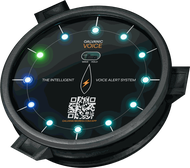




A sailing boat is a small power station with no grid behind it. Every Watt on board has a price — paid in solar real estate, in wind-generator bracket weight, in hydrogenerator drag through the water, in lithium-ion bank capacity, in noisy alternator hours, and in the small, repeated choice on a passage to turn one instrument off so another can stay on. Most marine electronics on the market are designed as if that price were zero. We decided early that ours would not be.
The Sailor’s Quiet Negotiation, Every Night of Every Passage
On a sailing boat at sea, the conversation about electricity is constant and quiet. The fridge cycles. The autopilot drinks. The chartplotter glows through the night. The radar swings every twelve seconds. Each one is useful, each one is reasonable, and the sum of them is a slow drain that the boat must keep pace with. On a perfect Caribbean day with 1.1 kW of solar on the bimini, that is no problem. On day four of a Biscay crossing under reefed canvas in fog, it very much is.
The result is a kind of quiet negotiation that almost every offshore sailor will recognise. The depth alarm gets armed for the channel and disarmed once you are out. The radar goes from active to standby. The chartplotter gets its brightness wound down at night. The instrument network gets one head turned off because the other was already showing the same data. Most of this happens without anyone naming it. It is the sound of a sailor rationing electricity from a budget the manufacturer never had to think about.
The Numbers Behind the Pain
Some real figures for a moderately equipped cruising boat at sea. These come from publicly available manufacturer datasheets for representative marine instruments across the common size classes; they are deliberately anonymous, since the point is the order of magnitude, not the brand.
| Instrument | Typical draw | Energy per 24 h |
|---|---|---|
| 9″ MFD chartplotter (active) | 12 – 18 W | 290 – 430 Wh |
| 12″ MFD chartplotter (active) | 20 – 30 W | 480 – 720 Wh |
| 16″ black-box MFD (active) | 35 – 50 W | 840 – 1 200 Wh |
| Typical cruising boat: helm + chart-table MFDs running | 30 – 50 W | 720 – 1 200 Wh |
| Open-array radar (transmitting) | 30 – 40 W | 720 – 960 Wh |
| Open-array radar (standby) | 5 – 10 W | 120 – 240 Wh |
| Broadband CHIRP radar (scanning) | 17 – 25 W | 410 – 600 Wh |
| Autopilot at sea (40 ft cruiser, average) | 5 – 10 W | 120 – 240 Wh |
| AIS Class B transceiver | 0.5 – 2 W | ~24 Wh |
| 12 V fridge (cycling, daily average) | 15 – 25 W | 360 – 600 Wh |
| LED nav lights (full set, 12 h underway) | 5 – 10 W | 60 – 120 Wh |
| VHF radio (receive / occasional transmit) | 0.5 – 5 W | 12 – 60 Wh |
| Instrument network (wind / depth / speed displays) | 1 – 3 W | 24 – 72 Wh |
| Galvanic Voice — April 2026 firmware | 1.1 W | 26 Wh |
| Galvanic Voice — software target, next firmware release | 1.0 W | 24 Wh |
A modestly fitted-out cruising boat at sea is burning 100 – 150 W constantly — call it 2.5 to 3.5 kWh per day. The renewable generation budget that has to keep pace with that draw is, even on a well-equipped boat that stacks everything — solar on the bimini, a wind generator on a stern pole, a hydrogenerator on the transom — bounded at a few hundred Watts of average output, not the thousands many sailors imagine. Our 1.1 kW of solar gives back maybe 5 kWh on a good Caribbean day, 1.5 on a cloudy windward leg. A 400 W wind generator in steady trades adds another 1 to 2 kWh; a hydrogenerator underway at five knots can add another 1 to 3 kWh — at the cost of a measurable drag on the hull. Stacked at their best, the realistic combined budget on a well-equipped cruiser sits somewhere around 200 to 500 W of average generation, and every Watt of it already has a load waiting. Adding a Galvanic Voice to that picture costs 1.1 W today, and 1.0 W as soon as the next firmware closes the last 100 mW. The autopilot will not notice. The fridge will not notice. The sailor will not have to choose between safety and electricity to pay for it.
manufacturer datasheets and product manuals for representative marine
instruments across the 7″ to 16″ MFD class, open-array and
CHIRP marine radars, Class B AIS transceivers, 12 V compressor
refrigerators, and Marine Equipment Directive (MED)-approved LED
navigation lights. The Galvanic Voice figures are bench-measured on
production hardware (April 2026 firmware); the ≤ 1 W target
is the next firmware release’s design specification.
And storage is the other half of the cost
Generation is only half the price of a Watt. Every Watt-hour a sailor produces also has to be stored, and storage on a sailing boat is expensive in every dimension that actually matters at sea: in weight, in volume, in management complexity, and in the long tail of complications that come with carrying chemistry through bad weather.
A modern lithium-iron-phosphate (LiFePO4) house bank — the current best-in-class chemistry for cruising sailboats — weighs roughly 8 to 10 kg per kWh of usable capacity at the pack level. A 4 kWh bank, the kind a moderately equipped offshore cruiser carries, is about 30 to 40 kg of dense, energetically full cargo bolted somewhere below decks that cannot easily be reached. Older AGM and gel banks — still common on many cruising boats — weigh roughly three to four times more for the same capacity, 100 to 140 kg for the same 4 kWh, and degrade faster.
And that weight is the easy part of the price. The bank has to be carried, stabilised, wired, fused, monitored, balanced, charged with the chemistry’s correct algorithm, kept above freezing, prevented from over-discharge (which permanently kills capacity), and — sooner or later — replaced when it fails, almost always at a marina, almost always at significant cost, almost always when the boat needed to be sailing instead.
The honest engineering answer to “how do you store more energy on a sailing boat?” is that you do not — you use less. Every Watt that a marine instrument does not consume is a Watt that does not need to be generated, stored, weighed, fused, monitored, balanced, charged, or replaced. The cheapest, lightest, safest, most reliable Watt-hour is the one you do not spend. Frugality on a marine instrument is not a virtue. It is structural.
Where the Wrong Design Assumption Comes From
Most marine instruments are designed by engineers who never crossed an ocean on a sailing boat. We do not mean that as an insult — it is a structural fact. The marine-electronics industry was built around two markets that look, at first glance, the same and are in fact almost opposite: commercial vessels running on diesel-generator power, and powerboat day-trippers running on an alternator that recharges the bank every time the engine turns over. Neither has an electricity problem. Shore power is forty feet away. The engine is going to run again in three hours.
Cruising sailing boats are the third category, and they are the category the industry has quietly assumed will keep up. We will not. The sun does not always shine — least of all under reefed canvas in fog, four days into a Biscay crossing with the swell on the bow. The engine is the thing we sailed in order not to run. The battery bank is the thing the autopilot, the fridge, and the navigation lights are already arguing over. A device that draws 6 W twenty-four hours a day, while the panels are producing zero and the engine is silent, is asking the sailor to fund it with attention they were planning to spend on the watch.
The Constraint We Set Ourselves: One Watt, Average
We picked the number deliberately. The design target was a continuous average draw of one Watt, twenty-four hours a day, over the course of an offshore passage including bursts (TTS rendering, alert chimes, MQTT spikes, brief radio activity). Not because 1 W is a tidy marketing figure — but because 1 W is, in operational terms, *the autopilot does not notice you exist*. It is *the fridge does not have to argue with you*. It is *the night watch does not have to choose between hearing the alarm and seeing the chart*. Anything that cost more than that, we decided, would not belong on a sailing boat. No matter how many features were printed on the box.
That decision shaped every other engineering choice that followed. The order of those decisions is worth writing down, because the order is the argument.
Four Decisions, in the Order They Were Made
Choose the brain for its idle power, not its peak
Marine instruments have to be responsive when something happens. They do not have to be busy when nothing is happening. Most of the work the boat asks of any monitoring system happens in bursts — a CPA crosses a threshold, an alarm fires, a TTS sentence renders. Between bursts, the silicon should disappear. We chose a compute platform whose idle draw is under half a Watt; whose wake-from-sleep is sub-millisecond; whose peak, when it has to be, is comfortably high enough to handle real workloads. That is the opposite of the chartplotter philosophy, which keeps the screen, the GPU and the network stack lit continuously because the user might glance at them.
Light where the eye is — because a screen cannot beat the sun
The first question is whether the boat needs broad illuminated surfaces at all. The honest answer, when you do the arithmetic, is that it does not — and that broad illumination on a sailing boat is fighting a battle it cannot win.
A short physics interlude, since the geometry is clean enough to write down. A 10-inch screen in the common 16 : 10 aspect ratio has a face area of roughly 0.029 m² — call it 0.03 m². On a sunny day, the sun delivers about 1,000 W of broadband optical power per square metre to every surface facing it (the “one-sun” AM1.5 value at sea level). That means, at the worst case where the screen happens to be perpendicular to the sun, roughly 30 W of solar radiation lands on the panel face; at a more typical 30–45° off-perpendicular at the helm, somewhere between 21 and 26 W. Either way, the screen is being illuminated by twenty to thirty watts of incoming light — not “several watts” as the first draft of this post originally implied.
But broadband watts is not the right yardstick for legibility. What matters is the luminance of the rendered image (measured in cd/m², commonly called “nits”) against the luminance of the ambient sunlight reflected off the screen’s own glass. A typical LCD diffusely reflects on the order of 5% of incident light even with anti-reflective coatings; at outdoor noon illuminance of around 100,000 lux, the reflected luminance off the screen surface is on the order of 1,600 cd/m². The display must put out more than that just to break even with its own reflection.
That sets up a useful ladder, with very different power costs at each rung:
- Acceptable readability — about 2,500 to 3,000 cd/m², marginally dominant over the ambient reflection. The better marine chartplotters sit here today. The electrical cost is in the tens of watts — typically 30 to 50 W at peak brightness on a 10-inch panel.
- Genuine dominance — around 16,000 cd/m², roughly ten times the reflected ambient, where the rendered image is unambiguously brighter than the sunlight on the surface. The electrical cost is in the hundreds of watts — somewhere around 200 W on a 10-inch panel. No consumer marine display is in this range, and on a cruising boat’s power budget, none ever will be.
The figures behind this ladder come from a simple linear scaling: LCD architecture delivers roughly 5 to 15 cd/m² per electrical watt on a panel of this size (the colour filters absorb most of the backlight; only a small fraction leaves the glass as image light), and the 1,000-nit “sunlight-readable” marine chartplotter at 12 to 18 W of input is the well-documented anchor point of the scale. Everything else scales from there.
Both of the lower rungs are nonetheless dwarfed, on a passage budget, by the next number. A device that is meant to monitor the boat twenty-four hours a day does not get to draw “acceptable readability” power only briefly at peak brightness — it draws something close to it for most of the daylight hours. Thirty to fifty watts, continuously, for a day, is somewhere between 0.7 and 1.2 kilowatt-hours. Two such devices is two-to-three kilowatt-hours. On a cruising boat that runs the rest of the night’s load (refrigeration, autopilot, instruments, navigation lights) on a battery bank charged from limited solar or a noisy diesel charger, this is the entire energy story. It is the reason every sailor has the brightness toggled down at night and the screen off when nobody is at the helm. The screen is power-hungry precisely in the regime where you most need it not to be.
The engineering conclusion is uncomfortable but clean: a screen is the wrong tool for primary alerting in daylight on an open deck. It is in a contest with a star, and the star is winning by a margin no affordable display can close. The contest goes away the moment you stop trying to win it.
We did not try. A boat does not need broad illumination — it needs focused light at the moment the eye looks at it. Concentrated LEDs in a small directed surface, behind glass, deliver more usable signal per milliwatt than any backlit panel ever can. The brightness curve is set by what the human pupil can read, not by what looks impressive in a chandlery showroom. At Caribbean noon the LEDs ramp briefly to their maximum; at three in the morning with dark-adapted eyes they drop to a milliamp or two. Same alert. Two orders of magnitude less power. No choice required of the crew. And — the part the sun cannot fight — the truly urgent information is delivered to the ear, not the eye, by voice.
Let the boat tell the device how bright the world is
A small ambient-light sensor runs continuously and adjusts the LED intensity automatically. Most marine instruments have a “day / night” toggle, and many sailors forget it. Forgetting it costs nothing on a chartplotter that is happy to drink power either way. On a device whose whole design rests on milliwatts, it would be the difference between running and not running. So we took the toggle away from the human, and gave it to the photosensor.
Make the device measure its own consumption — honestly
The device continuously measures its own current draw, its bus voltage, and the local board temperature. This is not a clever adaptive subsystem — it is a diagnostic and safety primitive. It catches abnormal draw before it becomes a customer-support call. It lets us track aggregate behaviour across the fleet. It gives the audio amplifier a hard power-limit reference so that the boat’s 12 V bus does not see an uncontrolled transient when the device speaks. And — the part that matters for any honest engineering claim about average draw — it is the reason every number in the table above is a measurement and not a marketing estimate.
Where We Are, and Where We Are Going (April 2026)
Today’s firmware draws 1.1 W average on bench measurement — already inside 10 % of the target. The remaining 100 mW are a software problem, not a hardware one: smarter wake-from-sleep transitions, tighter MQTT broker housekeeping, deeper batching of low-priority telemetry, more aggressive duty-cycling of background services. The silicon is already where it needs to be. The last 100 mW will close through over-the-air firmware updates, on units already in customers’ hands.
That clause matters more than it looks. The boat that bought the device last month is the same boat that will benefit from the next firmware release — without buying anything else, without an installer visiting, without the recurring fee that most “improvement” in the marine industry quietly attaches to. Frugality includes how we ship improvements, not only how we draw current.
Why the One-Watt Test Belongs in Every Marine Spec
Power frugality is not a marketing checkmark on a brochure. It is the first engineering constraint of any piece of equipment that is going to live on a sailing boat. Anything that ignores it is — by the evidence of its own datasheet — a piece of equipment for a boat sitting in a marina with shore power. That is a fine product. It is not a sailing product.
We would like to see the one-Watt test applied to every new marine instrument that calls itself a “monitoring” device. Add it to the passage. See whether the autopilot notices. If the autopilot notices, the device is too expensive — not in euros, but in the only currency a sailing boat keeps in short supply.
An instrument designed for sailors knows what the sailing day actually looks like — sun overhead, batteries draining, panels recovering, fog rolling in for the night — and behaves accordingly. The 1 W average is not a feature. It is the entry ticket.
Galvanic Works research — open-access preprints on fatigue and cognitive load at sea.
The 3AM Report — a free safety briefing on what hundreds of incident reports reveal.


Leave a Reply