
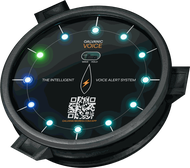




AIS solved one of the great problems of night-time sailing — knowing that the light on the horizon is, in fact, a 280-metre tanker bound for Algeciras. It did not solve the next problem, which is what you are supposed to do about it. This piece is about the gap, about the COLREG rule that is supposed to bridge it, and about the thing on the boat that finally does.
AIS is the best thing that ever happened to night watches. A trawler at twelve miles, with a name and an ETA, where there used to be a vague light somewhere on the horizon. It is genuinely magical — right up to the moment the CPA closes inside half a mile and the magic stops. Because at that point AIS has told you the problem. It has not told you what to do about it. Port? Starboard? Five degrees? Ten? Hold for how long? This piece is about that question.
What AIS Did for Night Watches
Worth saying up front — because it is true. The Automatic Identification System, invented in the 1990s and made mandatory for commercial vessels under SOLAS Chapter V from 2002, has transformed the calculus of night-time sailing. A pleasure boat with a Class B transponder, in 2026, can identify, track, and compute the closest point of approach to every commercial vessel within roughly 20 to 40 nautical miles, in real time, in any weather. The radar paints the targets. The AIS feed names them, sizes them, and tells you where they are bound. The chartplotter draws the lines.
This was not possible thirty years ago. Sailors who learned night watchkeeping in 1985 were keeping it by sight — a lone red light, a single white masthead — and trying to construct from those two data points a picture of where the ship was heading. AIS made that guesswork obsolete. We are not here to be ungenerous about it.
And Then the Magic Stops
The trawler is at twelve miles. The chartplotter has it on the screen, with a name, an ETA, a flag, a course. Some seconds later it is at ten miles. The CPA is being projected at 0.3 nautical miles in fifteen minutes. The mind, doing the kind of slow geometric calculation it does in the cockpit at 02:30, agrees that 0.3 nm is genuinely close. Something should be done.
And here the magic stops. AIS, having told you that a 280-metre tanker is going to pass three cables off your port bow in roughly a quarter of an hour, has nothing to say about what to do next. It does not recommend a course. It does not say whether you are the stand-on or the give-way vessel. It does not know what wind you have, or what point of sail you are on, or whether a ten-degree starboard turn is the safe answer or whether a ten-degree port turn is. It is a sensor. Sensing is what it does. Deciding is, by design, somebody else’s job.
That somebody else, on a cruising boat at 02:30, is you.
The COLREG Rule Nobody Quotes Properly
There is a popular misreading of the Collision Regulations that goes something like this: “I am the stand-on vessel. The right-of-way is mine. I hold course and they get out of the way.” It is, in calm-weather day-sailing within sight of a yacht club, a defensible approximation. It is, at 02:30 on a passage in the Mediterranean traffic-separation scheme, dangerous.
The actual rule, with its actual wording, is much more demanding. Rule 8 (Action to Avoid Collision):
“Any action to avoid collision shall be taken in accordance with the Rules of this Part and shall, if the circumstances of the case admit, be positive, made in ample time and with due regard to the observance of good seamanship. Any action taken to avoid collision shall, if the circumstances of the case admit, be large enough to be readily apparent to another vessel observing visually or by radar; a succession of small alterations of course and/or speed should be avoided.”
— COLREG Rule 8(a), 8(b)
And, more bluntly, Rule 2 (Responsibility):
“Nothing in these Rules shall exonerate any vessel, or the owner, master or crew thereof, from the consequences of any neglect to comply with these Rules or of the neglect of any precaution which may be required by the ordinary practice of seamen, or by the special circumstances of the case.”
— COLREG Rule 2(a)
The plain reading is uncomfortable but unambiguous. Even when you are the stand-on vessel, you are obliged to take positive action, in ample time, if the circumstances of the case admit and the ordinary practice of seamanship requires it. The misreading — “I hold course and they get out of the way” — does not survive a serious reading of either rule. The duty is active, not passive. The honest reading is: if a small course alteration would materially improve the encounter, the rules expect you to make it.
And Now the Joke That Is Not a Joke
There is a beautiful misreading of the rules popular among newly-AIS-equipped pleasure sailors. It goes: “I have a Class B transponder. I am sailing to windward. I am therefore the stand-on vessel against everything bigger than me that has a motor, and I can — in principle — go below and have a nap, secure in the knowledge that the rest of maritime traffic will respect my priority.”
This belief is wrong in two compounding ways.
The first mistake is that whoever holds it has not read the COLREGs all the way through — which is the subject of the previous section. The duty to take positive, early-enough action is active, not passive, and applies to stand-on vessels almost as squarely as it applies to give-way ones.
The second mistake is more practical, and one of our offshore-sailing instructors in Paris used to put it with admirable clarity. A large commercial vessel needs two to four nautical miles to stop, depending on tonnage and loading — and several more to turn. Those two to four miles are after the bridge has decided to stop, which is in turn several minutes after the bridge has decided that whatever they see on the AIS plot is worth thinking about. Stopping, in any case, is the least likely option they will choose. Steering off course is the next least likely. Every kilometre off the great-circle costs the operator real money in fuel and time, and any unexpected manoeuvre at 03:00 may require waking the on-call engine officer — which costs the company several thousand euros, and the master’s annual bonus a visible chunk of itself. The chance that any of these is the response you actually receive from a tanker at eight nautical miles, while your fourteen-metre yacht is sitting peacefully on their AIS plot, is — in commercial reality — approximately zero.
There is also a quieter horror to face. A large vessel has, ahead of its bow, an enormous blind zone. Under SOLAS Chapter V, Regulation 22, the watchkeeper is required to be able to see the sea surface to no more than two ship-lengths or 500 metres ahead of the bow, whichever is less. The bow itself, and the geometry of the bridge windows, hide the rest. A small yacht inside that blind zone is, literally and legally, invisible to the bridge — the rules do not require the watchkeeper to be able to see it. And it is precisely there — ahead of the bow, in the hundreds of metres the watchkeeper is not required by the rules to be able to see — that a small yacht in the wrong place may, in the worst case, end up forever.
The actual rule on a cruising boat is therefore: there is a big ship nearby, you get out of the way. Regardless of what the chartplotter is showing about who has formal stand-on rights. The Class B transponder did not turn the yacht into a vessel that a 280-metre tanker is going to inconvenience itself for. The transponder turned the yacht into a data point on a screen on the tanker’s bridge — assuming the bridge is even displaying Class B reports, which not all do — that will be noted, possibly recorded, and largely ignored.
This is, incidentally, what makes the AIS-tells-you-the-problem / Voice-tells-you-what-to-do logic of the next sections so material. The “what to do” answer that the system arrives at is almost always: recommend X degrees starboard, hold for Y minutes — i.e., you, the smaller vessel, alter course in a way that opens the encounter. Because the rules say so. And because the tanker is not going to.
Which Sounds Easy in the Office and Is Not Easy at 02:30
We have, between us, done this calculation in the cockpit too many times. CPA fourteen minutes out, target three points off the bow, the thought arrives: five degrees to port. Two minutes later we are not sure that was right. So we try five degrees starboard. Then we are not sure again. Then back to port. The geometry of two vessels moving at different speeds and on different headings is not intuitive to a tired human in a wet cockpit at three in the morning. A five-degree alteration can move the CPA from 0.1 nautical miles to 0.4 — or, on a slightly different relative bearing, can move it from 0.3 to 0.05. The same number of degrees, sometimes the same direction, can be the safe answer in one case and the dangerous one in another.
And the cost of getting it wrong is not academic. A succession of small course alterations — exactly what Rule 8(b) warns against — is what the tired human in the cockpit produces almost automatically, because the tired human is doing the only thing they can do: trying something, seeing whether it looked right, trying something else. Each small alteration is also a small signal of intent to the other vessel — and a succession of them is a confusing signal.
There is a quieter problem behind this. The AIS data the chartplotter is showing you is, by the nature of the AIS protocol, not real-time. A Class B position report arrives every three seconds at high speed, every thirty seconds at low speed. A Class A report arrives between two seconds and three minutes apart, depending on the vessel’s behaviour. By the time the chartplotter has drawn a target, that target’s actual position has already moved by some unknown fraction of the update interval. Doing the CPA calculation from the raw last-known position is doing it from data that is, in the worst case, almost a minute old.
What If the Boat Did the Calculation, and Then Spoke?
The Galvanic Voice is the system that answers the steering question rather than only the sensing one. The navigation service on board does three things that, in combination, change what is possible in the cockpit at 02:30:
- It runs the CPA / TCPA calculation on Kalman-filtered AIS data, not the raw last-known position. The Kalman filter tracks each target’s velocity and acceleration estimates between AIS updates, so the position the calculation uses is a prediction of where the target is now, not where it last reported being.
- It classifies the encounter against the COLREG decision matrix — head-on, crossing, overtaking — and determines whether the own-vessel is stand-on, give-way, or in a mutual-give-way situation. The decision is made by the firmware on the basis of the filtered bearings and aspect angles, not by a ruleset the human has to apply in the moment.
- It evaluates the encounter against the COLREG decision matrix and, for the side the rules allow, reasons about which alteration opens the gap and which does not. The output — given to the helm — is the encounter type, the geometry, and the COLREG-correct duty for the own-vessel: give way, stand on, maintain course, keep clear. The system narrows the cognitive task from “compute the crossing geometry from raw bearings” to “execute a rule you already know.”
And then — because none of that helps if it stays on a screen — the Galvanic Voice speaks. In a calm sentence, addressed to whoever is at the helm, in language taken straight from the rule-book:
“Crossing vessel to starboard, give way. Relative bearing zero-three-zero degrees. Distance one-point-eight nautical miles. CPA zero-point-two nautical miles. Time to collision nine minutes.”
(Verbatim template from the user manual — the COL_CS_ALARM message.)
And then, when the geometry warrants an actual alteration — when the give-way duty translates into a specific change of heading — the Voice follows up with a second sentence, equally calm and equally short:
“Suggest starboard twenty.”
(Verbatim — the COL_TURN_S20 message. Same family for ten, thirty, forty, fifty and sixty degrees; the ninety-degree variant — COL_TURN_S90, “Emergency starboard ninety now” — is reserved for the cases where there is no time left for politeness.)
A personal aside — from Piero, the inventor of the Voice.
I have spent a non-trivial fraction of my career on the algorithm that does the filtering and the prediction here. I first met it at CERN, where we used it to reconstruct the trajectories of subatomic particles flying through detectors that observed them only intermittently and noisily, and we asked the same question we are asking on the boat: given what we have measured, where is this thing actually going, and with what uncertainty?
The algorithm has a name. It is called the Kalman filter. I would dedicate a full post to it — and one day perhaps I will, because it is a beautiful object and it sits at the heart of half the things that work in the modern world. But I will not write that post today.
What matters for this post is the one-line summary: the Kalman filter is the magic algorithm that tells you, most probably, where the tanker will be at some point in time — and how confident you should be in that answer. It is what stands between a sequence of jittery AIS position reports and the calm spoken sentence at the helm.
The Galvanic app’s Traffic tab shows the same calculation as a split-screen animation, for the moments when you want to look at it rather than be told it. Your alteration. The target’s behaviour (updated as the target’s next AIS report arrives). The projected new CPA. You do not have to look; the voice has already told you the answer. The screen is there for the case where you want to understand it.
COLREG-aligned voice templates, the Traffic Tab geometry and
the Kalman-based CPA / TCPA reasoning are all laid out in the
Galvanic Works internal design documents that drive the firmware
and the app. The voice phrase quoted above is the verbatim
COL_CS_ALARM template from the user manual.
And — Worth Saying Plainly — What It Does Not Do
We want to be honest about the limit, because the limit matters.
- It does not steer the boat. The recommendation is delivered to the helmsperson, who decides whether to take it, modify it, or do something else. The system has no authority over the wheel and never will.
- It does not override the COLREGs. The recommendation is computed within the rules — it is always a course of action the rules allow for the encounter type at hand. On a stand-on vessel that is still required to maintain course, the recommendation will say so, and will update only when the rules require a give-way action (“in extremis” — Rule 17).
- It does not assume the target is going to behave well. The CPA calculation is re-run continuously against the target’s actual reported behaviour. If the target alters, the recommendation is reconsidered. The system is not making a one-shot prediction; it is watching. Any target. Any time. 24h / 24h. Every AIS information update arriving to your boat.
- It does not replace the look-out. Rule 5 still expects you to look. The Voice gives you a calm sentence so that you can do the looking instead of the mental geometry — but it does not relieve the eye on the horizon.
- It does not replace the rest of your toolkit. If you understand the COLREGs, the right discipline on a cruising boat is to watch the app, then the sea, then the MFD, then your gut feeling — and, when the situation is critical, all of them at once. You use every means available on the boat, not only one. The Voice exists to take the mental geometry out of the hot moment so that your attention can go on to the rest of those layers; it does not exist to replace any of them.
Sensing Solved Half the Problem. The Other Half Is What the Voice Is For.
AIS, twenty-four years after it was made mandatory for commercial traffic, has solved the question of seeing what is out there. It has not, by itself, solved the question of steering through it. The COLREGs make the gap between the two into a legal obligation, and the rules are quite clear that positive, early-enough action is required of you — including, frequently, as the stand-on vessel. The boat needs something that can do the geometry while the human does the looking.
That is what the Galvanic Voice does in this part of the system. Not a replacement for AIS. Not a replacement for the chartplotter. Not a replacement for the helmsperson. Just the calm sentence, delivered at the moment it matters, that closes the loop between the screen and the wheel.
AIS somehow gives you the information from the trawler. The Voice tells you what to do about it.
Addendum, for the avoidance of doubt
As every experienced sailor knows: not all boats have AIS, and most rocks don’t. The same goes for navigation lights — they help when they are on the things that have them, and that is not all the things.
The Voice reasons about what reaches it through AIS — and on a well-equipped coastal route, AIS does cover most of what is interesting. But it is not all of what is interesting. The fishing boat that has switched off its transponder. The unlit tender at three in the morning. The container half-floating after a storm. The granite, since the dawn of time. None of these will appear on an AIS plot, and the Voice will say nothing about them. The eye, the chartplotter’s depth and chart layers, the radar if the boat carries one, and the old discipline of slowing down when visibility drops, are the layers that cover the rest.
The Voice is a necessary element of a chain — and we have, for some time now, had ideas on how to make that chain better. Stay tuned.
Schrödinger’s Watchkeeper — the COLREG Rule 5 conflict, and the bracelet that admits it for you.
Galvanic Works technology — the engineering philosophy behind every design choice on the boat.


Leave a Reply