
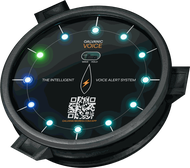




On every offshore passage there is a single COLREG rule that every sailor signs up to obey, that every sailor has to obey, and that no shorthanded sailor can fully obey. This piece is about the rule, about the physiology that makes it impossible, and about the wristband — the Galvanic Pulse — that exists to quietly admit the conflict on your behalf, before it becomes somebody else’s problem to discover.
You have been on watch for six hours. You feel fine. You are not fine. The same fatigue that is degrading your ability to scan the horizon is also degrading your ability to judge whether you are fit to be on watch in the first place. The most dangerous sailor on the boat at 03:00 is not the tired one. It is the tired one who is sure he is fine. This piece is about how you stop being that sailor — and about why the answer cannot come from inside your own head.
A Story We Heard on the Dock at Ortigia
The argument that follows reads drier without an anchor in the real world, so we will start with the story that anchored it for us. We heard it on the dock of the marina at Ortigia, the old town of Syracuse, from a sailor who had just finished an overnight passage from Malta to the Sicilian coast.
He had been on watch alone — fairly standard for a shorthanded passage in calm conditions. The crossing had been long. The previous night had been broken. The deck conditions on the second night were the deceptively friendly combination that does the damage: a steady following breeze, gentle waves rocking the boat in a slow, regular rhythm, the autopilot holding course with no inputs required of him.
He fell asleep at the helm. Not drowsed. Asleep. Fully asleep, slumped in the cockpit, with the boat continuing on a course it had been given some hours earlier and no longer adjusting for what was actually in front of it. The course was, with the small inevitable shifts of wind and current, taking the boat in the direction of the rocks of the Sicilian coast.
He was woken by somebody on the shore shouting at him — a stranger on land, close enough to see what was about to happen, watching a sailing boat tracking quietly and steadily towards rocks they could not see. The boat was minutes — minutes, not hours — from going on them.
He told us the story standing on the dock once the boat was safely tied up, with the pale honesty of someone who had just understood how their own boat very nearly destroyed itself by the most embarrassing route available. He said something we have not forgotten: “The most stupid way to lose a boat. And the most likely one, when you sail short-handed.”
He is right on both counts. And he is the reason this article exists — and the reason we built the bracelet so that the next sailor heading north from Malta on a quiet, gentle, perfectly fatal night does not need a stranger on the shore to shout him awake.
A gentle buzz on the wrist, every fifteen minutes, would have ended his story differently. It would not have woken him in panic. It would not have called the coastguard. It would not have told him he was an idiot. It would have asked him, politely and privately, to lift his head and look at the horizon. The first time he did not respond, the escalation would have begun — quietly, internally, on the boat itself. Long before any other sailor needed to shout at him. Long before the rocks decided the matter.
And — a small mercy worth saying — the bracelet would have kept him inside COLREG Rule 5 for the whole crossing. For the period he had been asleep, the boat that nearly went on the rocks was also, in the strict legal sense, in breach of the look-out rule. A discreet buzz on the wrist every fifteen minutes is also the cheapest, quietest, most dignified way to obey Rule 5 that has ever been built — and the only one that lets you wake up to the right kind of morning in Syracuse instead of the wrong one.
What the Galvanic Pulse Is For — Two Jobs, and a Third
Before getting into the science, it is worth saying plainly what the bracelet on the wrist is actually doing. It does two things, full stop. And during an active watch it does a third. Each of them is non-negotiable on a cruising boat at sea.
Job 1 — Make sure you stay on the boat
This is the negative-signal man-overboard layer covered in detail in Behind the Scenes of the Galvanic Pulse. The boat listens for the bracelet continuously. The moment the bracelet goes silent — wrist out of range — the alarm fires, on the boat, at second one. You do not have to press a button. You do not have to be conscious. You do not have to be near another vessel. If you are on the boat, the bracelet is in range. If you are not, the boat knows immediately. This is the reason every crew member on board should be wearing one.
Job 2 — Measure your fatigue, honestly, over time
This is the layer the rest of this piece is about. The bracelet’s accelerometer is also a sleep-and-activity sensor. It builds, day after day, an objective picture of how much you actually slept, how restful that sleep actually was, and how much active motion has accumulated in the hours since. Across a multi-day passage it tracks cumulative fatigue — the difference between three rough nights and one — and gives the boat an honest read on whether the human about to take the watch is fit to do so. That is the answer to a COLREG problem the rest of this article will set out in detail.
Job 3 (during watches) — The captain’s watchkeeping reminder
A boat under way has obligations under COLREG Rule 5 — the watchkeeper has to maintain a proper look-out by sight, hearing, and all available means. On a shorthanded boat the captain may decide, and the system supports, that the watchkeeper should be prompted at a chosen frequency — every fifteen minutes, every five, every minute, whatever the conditions and the captain require — to actually perform the look-out scan. The Galvanic Pulse delivers that prompt as a small, discreet buzz on the wrist. The watchkeeper completes the scan and acknowledges with a gesture.
And here is the part that matters: that gentle, discreet wrist nudge is not the whole of the system. It is the anticipation of an escalation chain. A missed acknowledgement is not silently absorbed by the boat. It is the first link in a deliberate sequence that runs across the bracelet, the Galvanic Voice, the captain’s own bracelet, and — if necessary — the rest of the crew. The wrist nudge is the polite first intervention. The escalation is the part that catches a watchkeeper who has, without noticing, slipped off the watch into sleep. No reaction is not an option.
These three jobs are what the bracelet is for. Everything else it does is in service of one of them. The rest of this piece is the detailed argument behind Job 2 and Job 3 — because those are the ones a COLREG conflict makes impossible to handle by the watchkeeper alone.
The COLREG Rule You Cannot Obey
Rule 5 of the International Regulations for Preventing Collisions at Sea is unambiguous. It is also, in its unambiguous wording, impossible for a real cruising boat to comply with:
“Every vessel shall at all times maintain a proper look-out by sight and hearing as well as by all available means appropriate in the prevailing circumstances and conditions so as to make a full appraisal of the situation and of the risk of collision.”
— COLREG, Rule 5 (1972, as amended)
The three words that do the damage are “at all times.” On a short-handed cruising boat — two crew, three crew, a singlehander on passage — those three words describe a physical impossibility. Every human must sleep. Every watch handover is a moment when the incoming watchkeeper is less alert than the outgoing one was thirty seconds earlier. Every off-watch is a stretch of hours during which one of the two people responsible for the boat’s look-out is, by definition, not looking out at all.
The cruising-boat sailor signs up to Rule 5 the same way a commercial-bridge officer does — but the commercial-bridge officer has a watch rota, a second officer, a helmsperson, a captain on call. The cruising-boat sailor has, on a quiet night, one human at the helm and one human asleep. The law says “at all times.” The boat says, “at all times that one human can stay awake.” Those are not the same sentence.
And Past a Certain Hour, the Human Cannot Stay Awake Honestly Either
Even if you stay technically awake, the human nervous system degrades on a known curve. After roughly 17 to 19 hours of continuous wakefulness, cognitive performance on standard reaction-time and attention tasks is statistically equivalent to a blood-alcohol concentration of around 0.05 % — the legal driving limit in most of Europe. After 24 hours awake, the equivalence rises to roughly 0.10 %, well above the limit anywhere in the world. This is not a soft observation; it has been replicated in standard human-factors laboratories for decades.
“Fatigue, alcohol and performance impairment.”
Nature, 388(6639), 235.
DOI: 10.1038/40775. Subsequent replications and reviews in the
sleep-research literature (Williamson & Feyer, 2000; Belenky et al.,
2003) have confirmed the order of magnitude across reaction-time,
vigilance, and decision-making tasks.
Translated to a sailing watch, the implication is sharp. A skipper on the back end of a long passage, returning to the helm after broken sleep, has, on the standard curve, the cognitive function of someone who would be unfit to drive a car on land — and is being legally required, by Rule 5, to maintain a full appraisal of the situation.
And Worse — You Cannot Tell When You Have Crossed the Line
If the only problem were the curve, the solution would be obvious — sleep more, hand the watch over earlier, plan the rota with more margin. Real sailors who have done long passages do all of that, and it helps. The hard part is the second-order problem the curve creates: the very fatigue that is degrading your ability to scan the horizon is also degrading your ability to judge whether you have crossed the line into “too tired to be on watch.”
Sleep-research laboratories have measured this directly. Subjects kept awake for 24 to 36 hours score progressively worse on objective vigilance tasks and progressively better on their own subjective ratings of how alert they feel. Their measured performance falls; their self-reported confidence rises or stays flat. The most consistent finding in the entire fatigue-research literature is that people who are profoundly impaired by sleep deprivation believe they are functioning normally.
The most dangerous sailor on the boat is not the tired one. It is the tired one who is sure he is fine. And the sailor most likely to be sure he is fine is the sailor whose cognitive load on self-assessment is exactly the load his cognitive system no longer has the capacity to bear.
Schrödinger’s Watchkeeper
Quantum mechanics has a thought experiment in which a cat in a sealed box is simultaneously alive and dead until somebody opens the lid and looks. We are not going to torture the analogy past its usefulness, but a milder version of the same logic applies to a watchkeeper on a long passage. Until somebody from outside the situation collapses the question by measuring it, the watchkeeper is simultaneously fit to be on watch and unfit to be on watch.
The watchkeeper themself cannot do the measuring, for the reason described above — the measuring instrument is the very faculty that has been degraded by the thing being measured. The partner asleep below cannot do the measuring without waking up and asking, which wakes them, which defeats the rota. The chartplotter cannot do the measuring because it has no sensor pointed at the human. And the watchkeeper’s self-report, statistically, is the worst available data source on the boat.
The conclusion is uncomfortable but unavoidable. An honest answer to “is the watchkeeper fit to be on watch right now?” requires a measurement from outside the watchkeeper’s own head. Without that measurement, Rule 5 is being obeyed in name and quietly disobeyed in fact.
Why the Wristband You Already Own Will Not Do the Measuring
Plenty of sailors already wear a wrist-tracking device of some kind — a fitness band, a smart-watch, an actigraphy bracelet. Many of those devices include a sleep-tracking feature. They do not, unfortunately, work on a boat.
The published sleep-detection algorithms inside almost every consumer wrist device — the Cole-Kripke method (1992), the Sadeh algorithm (1994), van Hees’s open-source HDCZA classifier (2015) — are built to detect when a stationary office worker is asleep in a stationary bed. The signature they look for is absence of movement. They were validated against subjects sleeping in sleep laboratories, on solid ground, in beds that do not pitch.
Put one of those algorithms on a sailor in a bunk on a boat that is moving in a one-metre swell, and the algorithm sees motion. It labels the sleeping sailor as awake. The fitness band cheerfully reports a night of poor sleep that, in fact, was perfectly good sleep on a slightly bumpy mattress. The data the sailor takes away from a passage — and might use to judge whether their next watch is safe — is, in marine conditions, mostly noise.
Cole, R. J., et al. (1992). “Automatic sleep/wake identification
from wrist activity.” Sleep, 15(5).
Sadeh, A., et al. (1994). “Activity-based sleep-wake identification:
an empirical test of methodological issues.” Sleep, 17(3).
Van Hees, V. T., et al. (2015). “A novel, open access method to
assess sleep duration using a wrist-worn accelerometer.”
PLOS ONE, 10(11). All three classifiers were validated
against subjects in stationary beds and explicitly do not model
platform motion.
The Wrist Can Do the Measuring — If You Teach It About Boat Motion
Once you accept that an honest measurement of alertness has to come from outside the watchkeeper’s head, and once you accept that the existing consumer algorithms will not work in marine conditions, the engineering question becomes a sharper one. What would a wrist-worn alertness sensor that does work on a boat actually look like?
The Galvanic Pulse is our answer. It is a small bracelet, worn on the wrist, with an accelerometer that samples the wrist’s motion continuously. The classifier behind it is a marine-aware extension of the published HDCZA approach — modified to distinguish the gentle ambient motion of a sailor lying still in a moving bunk from the active motion of a sailor on watch, on the move, gesturing, working. The principles behind the extension are written up in detail in two open-access preprints we have published; if you want the peer-review-track version of the science, follow the links in the source-box.
Paper 1 — The Science of Fatigue at Sea: A Biomathematical
Model for Recreational Sailing.
doi.org/10.20944/preprints202603.1014.v2
Paper 2 — Multi-Day Fatigue at Sea: A Two-State Biomathematical
Model for Passage-Making.
doi.org/10.20944/preprints202604.1649.v2
What the bracelet measures is not the sailor’s self-report. It is the sailor’s actual behaviour — how long they actually slept, how restless that sleep actually was, how much active motion has accumulated in the hours since. Those numbers are then folded into a multi-day model of cumulative fatigue, because a single good night’s rest after three bad ones is a different state from a single bad night after three good ones, and the boat needs the difference.
The Wrist Nudge — Advisory in One Mode, Required in Another
The Galvanic Pulse carries a small buzzer and a tiny beeper. They are used for two different kinds of prompt that look similar from the outside and behave very differently in what happens next. The distinction matters because the consequences are different.
The fatigue advisory (Job 2)
When the alertness data suggests the wearer may be below threshold at a moment that matters — entering a busy traffic zone after twenty hours awake, helming through the dog watch with a building sleep debt — the wrist nudges. A short buzz, a short beep, and a sentence from the Galvanic Voice: “You have been awake for twenty hours. Consider waking the off-watch in the next fifteen minutes.” This is advisory. The sailor decides what to do with it. The bracelet does not lock out the autopilot, does not radio the coastguard, does not pretend to know better than the human on watch. It is an honest piece of information delivered to the person it concerns, at the moment most likely to change their next decision. The watchkeeper is the adult on the boat.
The watchkeeping reminder, and the escalation behind it (Job 3)
The same buzzer, used the other way, is the captain’s watchkeeping prompt. At whatever frequency the captain has set — every fifteen minutes in clear weather, every five in restricted visibility, every minute when threading shipping lanes — the bracelet nudges, the watchkeeper performs the look-out scan, and the watchkeeper acknowledges with a gesture. The buzz itself is identical to the advisory one in everything except what happens next.
Because here the rule is different. A missed acknowledgement is not silently absorbed. It is the first link in a deliberate escalation chain that runs across the bracelet, the Galvanic Voice in the cockpit, the captain’s own bracelet, and — if those three layers do not produce a response — the rest of the crew. The gentle wrist nudge is the anticipation of that chain, not the whole of it. The watchkeeper who does not respond has not made the prompt go away; they have started something. The chain is designed so that the boat catches the case the advisory cannot catch: the watchkeeper who has slipped off the watch into sleep without noticing it — the case the incident reports keep beginning with.
Two nudges. One advisory, one required. No reaction is not an option for the second of them.
Rule 5 Does Not Get Easier. The Decision Does.
COLREG Rule 5 asks the cruising sailor to do the impossible without admitting that it is impossible. Every offshore sailor who has done a long passage knows the rule is being honoured in spirit and not in letter, and most of us have lived to tell about it because nothing landed in the boat’s path during the hours we were below threshold. That is not a system to rely on indefinitely.
The wrist admits the conflict for you — quietly, objectively, by measurement rather than self-report — and tells you when the watch should change hands. The Rule itself does not get easier; the physiology behind it does not change. What changes is whether the decision to step aside is made by a tired person guessing about their own competence, or by a piece of data from outside that person’s head.
That is the only honest answer we have come up with to the question the COLREGs quietly ask every sailor on every night watch. The Galvanic Pulse is small, light, and quiet. It does not look like the most important piece of equipment on the boat. We have come to believe that, on a long passage, it is the most important.
Behind the Scenes of the Galvanic Pulse — the origin story of the bracelet, and the events that led us to build it.
The 3AM Report — a free safety briefing on what hundreds of incident reports reveal.
Man overboard alarm — the mathematics of dying alone at sea — what the numbers say about response time and survival in the water.


Leave a Reply