
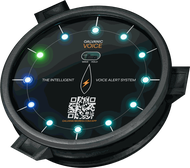




The anchor alarm built into a typical NMEA 2000 chartplotter is, if we are honest about it, almost the same product it has been for twenty-five years. You drop the anchor. You walk back to the helm. You press a button that records your present GPS position as the anchor location. You type in a radius — thirty metres, fifty, a hundred — and the boat now monitors a circle on a screen. If the GPS position leaves the circle, the alarm fires.
It is better than nothing. It is also, in 2026, a long way from what the boat could actually be doing for you. And before we get to the mechanics, there is one other thing worth saying out loud.
The Most Honest Use Case Is the Remote One
The use case the anchor alarm was actually designed for, deep down, is one that almost nobody talks about: the boat is at anchor, and the person who cares most about it is not on the boat. Sometimes the crew is dozing in a quiet bay; sometimes the boat is on a buoy at the home marina and the owner is two countries away. Best of all — and most honestly — sometimes the boat is floating gently in a beautiful anchorage and the owner has finally gone ashore to visit the city they have always wanted to visit, while the boat does what boats do. An anchor alarm that the owner can actually see, from a phone, in a café in another town, is the version of the product that justifies its name.
And here is the catch, and it is a serious one: the notification channel is the fragile part of the whole story. Whether the alert is meant to arrive on a phone in the café, or on a tablet on the bedside table while you sleep at the hotel, the device receiving the notification was not designed to monitor. It was designed to grab the user’s attention for things the operating system, the carrier, the app store, and the social-media platforms have all agreed are worth grabbing the user’s attention for. An anchor alarm is, almost by definition, not one of those things. We have written about this elsewhere — the phone is an attention-economy device, not a watchkeeper. Notifications are filtered, batched, deferred, occasionally suppressed; Do Not Disturb engages without telling you; the battery dies because nobody remembered the charger; the relevant phone is in the next room. Owners who genuinely care end up nervously checking the phone every ten minutes — which is the opposite of what owning an anchor alarm was supposed to feel like.
And then there is the failure mode that any honest sailor will admit to: the case where the alarm was simply not armed in the first place. We will not pretend that is rare. It is, in fact, the modal failure of every anchor alarm ever built. The boat dragged. The alarm was off. The owner found out from the marina office at half past eight in the morning.
A personal aside, from Piero — what I currently do, and what we are trying to make obsolete.
I will admit, on the record, what I have actually been doing on my own boat for the past several years. There is an iPad Pro on board, on which the existing marine system displays its anchor alarm. The ritual has three steps, each of which I have to remember separately, every single night. First, I have to remember to set the alarm app at all. Second, I have to remember to keep the iPad powered through the night — left to itself, the iPad Pro will helpfully go into power-saving mode, close the app and blank the screen well before morning, which is of course precisely the moment you most want it not to. Third, I have to remember to position a Blink camera in front of the iPad, with the camera pointed at the screen. (A Blink, for the reader who is not in the small-electronics weeds, is a wireless, battery-powered Wi-Fi household camera, made by Amazon, with its own phone app for remote viewing — the sort of device people use to watch a porch or a baby cot.)
Because the Blink streams to my phone on demand, I can be ashore, open the Blink app, and read the iPad’s anchor-alarm screen as if I were standing in front of it. No marine cloud subscription. No €200-a-year Remote Pro add-on from anyone. Just an off-the-shelf household camera, watching a marine tablet, watched by my phone.
It is a ridiculous setup. It is also, on the evidence of actually using it for years, more honest about the realities of monitoring a boat remotely than any monthly-subscription dashboard I have ever paid for. And it is, very deliberately, the kind of setup the Galvanic Voice is built to make unnecessary.
What follows in the rest of this post is how. None of the techniques described below require a household camera pointed at a tablet. The remote view — of the boat, of the anchor, of the swing circle, of the wind, of the neighbours, of every condition the boat is paying attention to — is in the owner’s app and on the helm’s screens simultaneously, because all of it comes from the same classifier on the boat. The owner who has gone ashore sees the same situation the cockpit sees.
A Circle Around a Point — and What That Misses
The “circle on a screen” anchor alarm gets several important things wrong at once.
- The recorded position is the position of the GPS antenna at the helm when you pressed the button, not the position where the anchor is actually lying. On a forty- foot boat with the antenna at the stern and the windlass at the bow, that is a ten-to-twelve-metre offset before anything else has happened.
- The radius is whatever number you typed in. It bears no necessary relationship to the chain you actually paid out, the depth you anchored in, or the windage of your boat. Set it too tight and the alarm fires every time the wind shifts. Set it too loose and the boat will be on the rocks long before the alarm decides to mention anything.
- The alarm reacts to a single condition: the GPS has left the circle. By the time that has happened, the boat has already moved. The crew is being woken to react to a drag in progress, not to a drag about to happen.
- The system has no idea what the wind is doing, what the depth is doing, what the neighbouring boats are doing, or what was, originally, the actual quality of the set you made before dinner. It is monitoring a number, not a situation.
First, the Boat Has To Know It Is Anchored
Before the alarm can do anything, the system has to know that the boat is genuinely at anchor — not motoring slowly through a harbour, not drifting with the engine in neutral for a coffee break, not moored alongside in a marina. We cover the general state-classification logic in The Boat That Knows What It Is Doing; the anchor-specific piece of it has three independent paths into the state, in descending order of confidence.
The engine path. If the engine gateway has just reported the gear in reverse — the standard backing- down sequence used to set an anchor — followed within moments by the speed-over-ground dropping to zero, the boat knows what just happened. The position at the instant of SOG-zero is recorded as the bow’s position at anchor drop. This is the highest-confidence path because every step of the sequence is observable.
The stationary path. If the engine data is not available, the boat looks instead at five minutes of almost-zero speed, an unstable heading (the boat is weather-vaning on the chain, not held fixed to a dock), no shore power, and — crucially — a location that plausibly admits an anchorage in the first place. The boat does not assert ANCHORED in two hundred metres of water in the middle of the open sea, or on a hard-charted shipping lane; it asserts ANCHORED where yachts actually anchor: within a sensible distance of the coastline, in a depth that makes sense for the rode a cruising boat carries, away from the traffic-separation schemes and the deep-water charted zones. The combination of stationary, weather-vaning, no shore power and in a place where anchoring is plausible is robust enough to assert ANCHORED on its own.
The manual path. The skipper can always confirm the deployment directly — by pressing “deploy anchor” in the app, by a gesture on the Galvanic Voice on the helm, or by a triple-press on the wrist bracelet of whoever is on the bow. Hands are usually busy on a bow with chain running out; the multi-modal confirmation is there for the case where reaching the app is awkward.
Then, the Boat Has To Know Where the Anchor Is
This is the part the chartplotter quietly skips. Where the anchor actually sits on the sea floor is not the same as where the helm-mounted GPS happened to be when the button was pressed.
The Galvanic Voice estimates the anchor’s true position through a sensor-fusion approach — running multiple independent estimators in parallel, each one producing its own position estimate with its own uncertainty disc, and fusing the discs together with inverse-variance weighting to produce a single best-estimate anchor position with a quantified confidence. No single method is asked to be infallible; the fusion is what is asked to be honest.
The methods feeding the fusion are:
- Bow track during deployment. If the engine-reverse path was used to detect the deployment, the system has, by definition, a GPS track of the bow during the entire backing-down. The anchor sits at the point on that track where the chain first went taut and the boat first began to weathervane. The track, corrected for the GPS-to-bow offset of the vessel, gives a direct geometric fix.
- Catenary inversion under varying winds. Given the depth, the chain length paid out, the boat’s windage and drag coefficient, the catenary equation describing the chain hanging from the bow predicts the horizontal distance from the anchor to the bow at any wind speed. From a sequence of bow positions observed under different winds, the system solves for the unique anchor position that is consistent with all of them simultaneously.
- Swing-centroid geometry. Over time, the centroid of the boat’s GPS scatter is — for a free anchor — the anchor position itself. A sufficiently long sample, with sufficient wind variation, places the centroid where the anchor is, within an uncertainty that shrinks as more samples accumulate.
- Heading-versus-wind triangulation. A free vessel weathervanes on the anchor: in calm conditions the bow points at the anchor, and in any wind the heading aligns with the apparent wind. From the recorded bow positions and the corresponding heading and apparent-wind data, the anchor lies at the intersection of the lines that each bow-heading vector traces back along.
- Depth-trace correlation. The depth sounder records a profile as the boat sweeps the swing arc. The seabed below the anchor itself, where the chain meets the bottom, has a particular signature (the chain-grounding zone) that can be located on the depth trace and back-referenced to the geometry of the swing.
- Manual operator declaration. The captain can mark the anchor position directly in the app, either at the moment of deployment or by walking the boat over the anchor afterwards. The declaration enters the fusion as a high-confidence measurement with a small uncertainty disc — but, like every other input, it is reconciled against the others rather than treated as overriding ground truth (a finger tap on a phone is itself subject to slip).
Each method produces a σ-disc — a region of likely anchor location with a quantified spread. The combined estimate is the inverse-variance-weighted intersection of the discs: methods that are confident pull the estimate toward them; methods that are uncertain widen the result. In good conditions — a clean engine-reverse deployment in moderate wind, the captain confirming on the app, the depth trace agreeing — the fused disc is a few metres across. In bad ones — a quiet, manual deployment in a calm, the depth ambiguous, the captain on the bow without the phone — the disc is honestly larger, and the alarm thresholds adapt accordingly. The system would rather admit uncertainty than fake confidence. (The multi-method anchor-position estimation, with per-method σ-discs and inverse-variance fusion across all of the methods above, is the subject of a pending patent application in the Galvanic Works portfolio.)
The Swing Circle Is Three-Dimensional, Not Two
Most other anchor alarms — to say this plainly — work on an even simpler picture than the Pythagorean approximation. They are two-dimensional. They look at the GPS position of the boat and the GPS position the helm tagged as the anchor location, and they compute the planar distance between the two. Depth does not enter the calculation. Wind does not enter the calculation. The chain itself does not enter the calculation. The alarm is, in effect, a flat circle drawn on a chart.
The Galvanic Voice’s anchor alarm is, by deliberate contrast, three-dimensional and wind-aware. The depth under the keel, the wind currently being measured, the chain length declared by the captain, and the windage of the boat are all simultaneously part of the swing-radius equation. The 2-D alarm is a circle on a chart; the 3-D alarm is the physically-correct envelope of where the boat can possibly be, given the chain it has out and the wind it is sitting in. (The wind-aware, three-dimensional swing-circle computation is one of the methods in our pending patent portfolio.)
At the heart of the 3-D picture is the catenary — the curve any chain hangs in between two points. Many chartplotter alarms, where they bother to compute a swing radius at all, use the Pythagorean approximation r = √(L² − d²): chain as a straight line, no weight, no wind, no chain on the bottom. This is, in any breeze, false. A chain in the water hangs in a catenary — a curve whose shape depends on the chain’s weight per metre, the horizontal tension applied by the wind on the boat’s windage, and the depth.
The Galvanic Voice solves the catenary equation directly, for every wind speed of interest, and tells you the true horizontal swing radius — and how that radius will change if the wind picks up. In light air, very little of the chain is off the bottom, the catenary is shallow, and the swing radius is much smaller than the Pythagorean estimate. In thirty knots, most of the chain is lifted clear of the bottom, the catenary is steep, and the swing radius approaches the Pythagorean upper bound. The same chain produces very different swing circles in very different conditions, and the boat knows which one is the right one for tonight.
There is a practical wrinkle to all of this. Solving the catenary equation requires knowing the length of chain actually deployed — and on the majority of cruising boats today, the chain length is not reported automatically. Modern NMEA 2000 windlasses (we cover them in a later section of this post) broadcast the chain payout in real time, and where that data is available the number goes straight into the equation. For everyone else, the system has to estimate it.
The estimate is built the way every sailor has always built it: from the depth, multiplied by the scope ratio the captain prefers. Every sailor has their own number, and it is, in our experience, mostly a matter of nationality and constitution. The French permis côtier teaches three-to-one; the British RYA teaches four-to-one; the Americans and Australians most commonly quote five-to-one; offshore cruising guides recommend seven-to-one. After enough nights at anchor, each of us has settled on a personal number — calibrated by experience, by taste, by derring-do, and by the occasional dramatic morning. Piero’s, for what it is worth, is five-to-one in calm anchorages: in three metres of depth he typically puts down fifteen metres of chain. The owner and the captain each set their preferred scope ratio once, in the app, and the system uses it from then on (the captain’s setting takes precedence for the duration of the current passage).
And — because no estimate can outrank the person who actually deployed the chain — the captain can always override. A tap in the app and the captain declares the real number: “I’ve put twenty metres down tonight, to sleep more quietly.” Fair enough. The system accepts the declaration as the authoritative value, the catenary equation re-runs with the new chain length, the swing radius is recomputed, and the alert thresholds are recalibrated. The hierarchy is simple: windlass-reported chain, where available, beats the scope-ratio estimate; the captain’s explicit declaration beats either.
Once the depth comes off the sounder and the chain length has been established by whichever of the three paths applies, the bow’s expected horizontal distance from the anchor follows from the catenary equation at the prevailing wind. Add the GPS-to-bow offset of the vessel, and the boat now knows — with quantified uncertainty — where the GPS antenna sits on the surface of the water relative to its own anchor below. Nobody had to type a number after the set, unless they wanted to.
The Boat Becomes Its Own Anemometer
Running the catenary equation in real time has an unexpected and rather satisfying side effect. The relationship between observed swing radius and prevailing wind speed is, for a given boat with a given chain at a given depth, a curve that depends only on the boat’s drag coefficient and its windage area. Over the first day at any anchorage, the system observes a sequence of (wind, radius) pairs and fits that curve — calibrating, in effect, the drag of this particular boat as it is currently rigged (bimini up or down, dinghy on deck or in davits, sails covered or not — all of these change the windage, and the calibration absorbs them).
Once calibrated, the boat is a precise anemometer for itself. At every wind speed, the system knows the swing radius the boat ought to be sitting at — and conversely, from the observed swing radius alone, the system can infer the wind better than most masthead instruments. The two estimates check each other continuously: a divergence between the observed radius and the expected radius is itself an early-warning signal, because something in the equation — the chain, the anchor, the windage — has changed.
Why the Chain on the Bottom Is the Whole Game
Most cruising sailors learn this the hard way, and the physics is worth saying out loud: your holding at anchor is approximately proportional to the amount of chain actually resting on the bottom. The chain on the seabed contributes friction (every metre of 10 mm chain adds roughly a kilogram of frictional resistance against sand), but, far more importantly, the chain on the bottom is what keeps the angle of pull at the anchor close to horizontal. A horizontal pull is what every modern anchor design needs in order to dig in and stay dug; a vertical pull is what you use to retrieve it.
As the wind picks up, the chain lifts off the bottom link by link. The friction component shrinks. The catenary flattens. The angle at the anchor begins to rotate from horizontal toward vertical. The transition is gradual at first and steep at the end. A boat that has, in light air, twenty metres of chain on the seabed and six metres in the catenary is in a very different mechanical situation from the same boat with two metres on the seabed and twenty-four in the catenary — even though both pictures look identical on a 2-D anchor-alarm circle.
The Galvanic Voice knows the wind, knows the depth, knows the chain, knows the boat’s calibrated drag, and knows the present swing radius. It can therefore compute, at every moment, how much of the chain is on the bottom. As that number shrinks toward zero, the system raises an early WARNING — long before the position-based 2-D alarm would have anything to say — because the boat is approaching the part of the curve where small additional gusts produce disproportionately large reductions in holding. (We have written, at much greater length, about the underlying chain physics in our piece Anchoring Physics: The Real Chain Reaction; the very short version is reproduced here.)
A Warning Before the Rode Runs Out
One of the most useful pieces of the system is the one that fires before the boat has moved. From the catenary equation, it knows the maximum wind the present rode can hold without dragging — the catenary vmax for the chain you deployed at the depth you anchored in — and it watches the wind the boat is actually sitting in against that limit.
When the measured wind climbs toward catenary vmax, a calm WARNING-level voice message is delivered to the helm and a vibration to whichever bracelet is being worn. Nothing has yet gone wrong; the chain has not yet started to slip. The boat is, in effect, saying: “the wind is reaching the limit of the rode you set tonight.” The skipper has time to let out more chain, to start the engine, to reset, or to leave — while a conventional circle-on-a-screen alarm still has nothing to say, because the boat has not yet moved. (The catenary-limit vmax warning is patent-pending.)
Pleasure Boats Are Not Commercial Vessels — and the Alarm Has To Know It
The international rules of good seamanship — and the professional traditions sitting behind them — are written for vessels that maintain a watch at all times, including at anchor. A merchant ship in roadsteads has, by professional standard, a watchkeeper on the bridge through the night: eyes on the weather, the instruments, the chain, the swing, the neighbours. The transition between “at anchor” and “starting the engine” is, in commercial practice, a matter of seconds — because the bridge is always manned.
There is, in our view, no other situation at sea where the gap between the regulatory ideal and the recreational reality is as wide. We have never seen a pleasure boat at anchor with a continuous watch. We do not pretend we keep one ourselves. The captain checks the chain, sets the alarm, opens a bottle of wine, and goes to bed — and the on-call posture of the entire crew, for the night that follows, is whatever the alarm has time to wake them into.
The dramatic version of that gap was made unambiguous on the night of 19 August 2024, off Porticello, in Sicily, when a superyacht — fully crewed by professionals, with a watch nominally on duty — was lost in a sudden severe weather event whose consequences have been widely documented in the press and are still under investigation by the relevant Italian and United Kingdom authorities. We will not speculate on the specific causes; that is what the formal accident reports are for. What is unarguable is the broad lesson: a vessel that had every advantage of professional crewing was caught out by how little time the weather actually gave them. For those of us aboard pleasure boats — with no watch at all — the lesson is more direct still. The alarm has to be early. It has to wake the crew while there is still time to act, not after the situation has become an emergency.
In anchor mode, the Galvanic Voice therefore runs a deliberately strict monitoring policy on the two signals the weather usually announces itself with first. The wind is watched continuously against the rode’s catenary limit, as the previous section describes. The atmospheric pressure is watched in parallel — and a falling barometer is one of the oldest and cleanest leading indicators a sailor has of a developing blow. When both signals move the wrong way together, the Galvanic Voice escalates while the situation is still calm. The on-call crew — i.e., everyone aboard, asleep — is given the early warning a professional watchkeeper on the bridge would have raised themselves. The recreational gap, in this one corner, is closed by the system.
And Depth — Especially Depth — at Anchor
The Galvanic Voice in anchor mode treats every small change in depth more seriously than it would in any other situation. At sea, the depth trace is watched with sensible patience: a gradual decrease as the boat approaches the coast is the normal physics of a passage, and the system reacts to a sustained downward slope rather than to every minor wiggle. At anchor, the opposite policy applies. Centimetres matter. Every unexplained movement of the depth signal is, by default, suspicious.
There are only two innocent explanations for a depth change at anchor, and the boat knows them both:
- Tide. The classic predictable change — gradual, hours-long, well-modelled. The system subtracts the expected tidal contribution at the anchorage’s location before it alerts on anything; the cockpit sees the absolute depth, and the decision logic sees the residual above (or below) the tide model. Only the residual triggers anything.
- Surface motion. Wind chop and swell move the boat (and therefore the transducer) up and down by small amounts. Heave amplitude is measured by the same attitude sensor the polar uses for sea-state; the depth alert logic ignores the part of the signal that the IMU has already explained.
Everything else is, until proved otherwise, a cause for attention.
- A sudden depth drop while the GPS position is steady. The boat is sitting still and the sounder has suddenly seen a different bottom. This can be a rock, a ledge, or some other charted or uncharted obstruction in the swing arc that the boat had not previously been over — i.e., it is location-specific: it depends on where on its swing the boat happens to be. The Galvanic Voice reports it the first time it sees it (“Depth four-point-five metres at this bearing”), and remembers the geometry so it does not re-report on subsequent swings over the same patch.
- A sustained depth decrease while the GPS position is also moving. This is the unambiguous case. Two trends both turning the wrong way at once — the boat walking, the seabed rising under it — is the canonical asymmetric-danger signature from elsewhere in the architecture. The Galvanic Voice escalates to a clear, urgent message at the helm and to the captain’s bracelet: “Depth decreasing while position is changing. Check the anchor.”
- A rapid change in depth at constant tide. Faster than the tide-model expects, and inconsistent with surface motion. Either the boat has displaced to a new local bathymetry, or the bottom has done something the chart did not anticipate. Either way, the system says so out loud.
The shoaling threshold itself is markedly tighter in anchor mode than in any other vessel state — a downward slope that would have been quietly tolerated underway produces a calm announcement at anchor. The reasoning is the same as elsewhere in the system: the cost of bothering the crew about a depth change that turns out to be the tide is small. The cost of not bothering them about a depth change that turns out to be the bottom coming up to meet them is the boat.
The Boat Knows the Difference Between an Anchor and a Buoy
A boat on a mooring buoy is not a boat at anchor — and the system recognises that, automatically, from the geometry of the swing. The discriminator is simple: an anchor needs a scope ratio of three-to-seven-times-depth to hold; a mooring pendant is a few metres long whatever the depth. So a swing radius too small for any credible anchor scope, at the observed depth, is by elimination a boat on a buoy.
Once the boat classifies itself as on a buoy, the alert profile shifts. Tighter swing tolerances. Higher sensitivity to any genuine slip — because a buoy that has come adrift is a buoy taking its boat with it, and the consequences accumulate quickly. The owner can also declare the position explicitly (“this is my mooring”), and the override stands. Whether the classification comes from the geometry the boat computes by itself, or from the owner’s declaration, the alarm behaves the way a boat on a buoy needs the alarm to behave.
Before You Lift It — Is the Anchor Free?
A fouled anchor — one wrapped around a rock, a chain, a wreck, a cable, an unmarked mooring — is a problem that announces itself at the worst possible time: when you are already trying to leave, the windlass is straining, the boat is creeping over its own anchor, and the marina you meant to reach this evening is now thirty miles further than you planned. Most yachts find out their anchor is fouled at the moment they try to lift it.
The Galvanic Voice looks for the fingerprints of a fouled anchor during the night you spend on it, while there is still time to plan a response. Three geometric signatures are watched, continuously, while ANCHORED is asserted:
- Swing-radius mismatch. A free anchor produces an observed swing radius close to the catenary prediction at the prevailing wind. A foul, where the chain is hung up on something below, produces an observed swing radius noticeably smaller than predicted — the chain is being held short by whatever it has caught on, not by the anchor.
- Bow-bearing misalignment. A free vessel weathervanes with the bow pointed at the anchor. A fouled vessel pivots around the foul point — usually not where the anchor was recorded — and the bow-to-anchor bearing stops matching the wind in the way it should.
- Swing-centre offset. The centroid of the boat’s GPS scatter ought to sit on the recorded anchor position. If the centroid drifts off to one side, persistently, the boat is pivoting around a point that is not the anchor — i.e., around the foul.
When at least two of the three signatures are sustained for long enough across a varied-wind session, the Galvanic Voice delivers a non-blocking pre-departure warning: “Anchor may be fouled. Plan retrieval accordingly.” It is information, not an alarm — the night still goes on. But it is information the skipper has at sunset, not at the windlass. (This pre-departure fouled-anchor detection is, again, a patent-pending method.)
Watching the Boats Around You — and Using Them as a Reference Frame
One of the under-appreciated risks of a crowded anchorage is not your own boat dragging. It is the boat up-wind of yours dragging, and finishing the night anchored on top of you. A neighbour that has dragged half its swing circle is, geometrically, two-thirds of the way toward your bow. Conventional anchor alarms — own-vessel- only by design — have nothing to say about this until the moment of contact.
The Galvanic Voice takes a much more ambitious view of the problem. The insight at the heart of it is one a sailor with a few crowded nights at anchor will recognise immediately: at anchor, the dominant thing that moves every boat in the bay is the wind — and the wind moves every boat at once. When a fresh breeze veers thirty degrees over twenty minutes, every anchored vessel in the anchorage swings; each one rotates around its own anchor, all of them turning roughly the same way at roughly the same time. Your own absolute GPS has shifted by several metres in the process. The chartplotter’s circle- on-a-screen alarm has no way to know whether that shift was the wind taking you around your anchor, or your anchor letting go and the boat starting to walk.
The neighbours are the answer. They are anchored in the same bay, in the same wind, and they are responding to it in the same way. If your boat has moved ten metres and every neighbour has also moved ten metres in roughly the same direction, the wind shifted and the whole bay shifted with it — nothing is wrong. If your boat has moved ten metres and the neighbours have not, you have moved. The neighbours’ positions filter out the common-mode wind effect on the swing geometry of the whole anchorage and leave behind only the differential signal — the part of your motion that is actually yours.
Two genuinely useful pieces of information follow from this insight, on top of the conventional drag-detection story:
- A neighbour is dragging toward you. For every AIS-reporting vessel within a sensible radius (about a nautical mile), the system keeps a rolling position history over the last half-hour. Each neighbour’s swing pattern is fitted — anchored boats swing cyclically around a centroid that is, on average, stationary. When a neighbour’s centroid stops being stationary and starts walking in a consistent direction, that is the signature of a drag in progress. The closing rate of the neighbour toward your own position is computed; if it is positive and sustained, a CAUTION-level alert is raised (“Vessel [name], bearing [X], has moved twenty-two metres toward us in the last nine minutes”), escalating to WARNING and then ALARM as the time-to-contact shrinks. A boat upwind of yours that has started slipping is, by itself, a danger — and the system says so before the contact.
- You are dragging, even if you cannot tell from your own GPS alone. This is the inverse case, and it is the one absolute-position alarms struggle with. Imagine that your own GPS shows you slowly walking downwind — but the GPS noise is also a slow walk on the scale of metres per hour, and a recent satellite- geometry change has nudged everyone’s position by a similar amount. Are you dragging, or is the entire constellation having a moment? The boats around you — also anchored, also AIS-reporting — are the answer. If you are walking downwind while every other boat in the bay is steady on its swing centroid, you are dragging. If you are walking downwind and so is every neighbour by a similar vector, the satellites have moved and the bay has not. The neighbours give you a reference frame the satellites alone cannot.
The combination — own-vessel motion, watched in the reference frame of every nearby anchored boat, with the swing pattern of each neighbour also being watched against the same boats — extends the anchor watch outward from a self-monitoring function into a perimeter watch. (The neighbour-vessel drag detection method, including the relative-frame analysis described above, is the subject of a pending patent application.)
We will say one honest thing about this. This feature is still under tuning. The parameters — the radii, the time windows, the closing-rate thresholds, the spectral cuts that separate cyclic swinging from genuine drift — need a lot of real-world anchorage hours before they settle into their final values. It is integrated into the Galvanic Voice today, and it is firing in controlled trials; the conservative, public-facing tuning of it is something we will keep refining over the coming seasons. We are not pretending it is finished — we are saying it is real, and that we plan to make the very best use of this information.
And When You Lift the Anchor, the Boat Guides You Back to It
There is a small and rather useful consequence of the boat knowing exactly where the anchor actually sits on the seabed: when you start the engine in the morning to weigh anchor, the Galvanic Voice can guide you back to it.
As some companies have correctly recognised, this is the moment of the day when marriages get tested — we are happy (and frequent) users of the “Marriage Saver” wireless headsets ourselves. Anyone who has weighed an anchor in any meaningful wind knows the usual choreography. The captain at the helm motors slowly forward, trying to put the bow directly over where they think the anchor is. The crew member at the windlass is hauling chain, watching the rode, and shouting course corrections back across thirty feet of wind and engine noise: “more to port — no, your port — slow down — slow down — you’re past it.” It is the moment, every morning, when the calm of the anchorage briefly stops being calm.
The moment the engine is started and forward gear is engaged, the Galvanic Voice has everything it needs to do the talking instead. It knows the present GPS position, knows the recorded anchor position (with the σ-disc of the fused estimate from Section 3), and knows the bearing and distance between the two. The MFD displays the anchor as a directed line from the bow; the Galvanic Voice speaks the instructions:
“Anchor twenty-two metres ahead, ten degrees to port.”
“Twelve metres. Two degrees to port.”
“Three metres. Hold.”
The helm can look at the screen, or simply listen. The crew member at the bow stops needing to shout course corrections through the wind and the engine. The captain at the helm stops needing to guess. The stress goes out of the morning, and the manoeuvre becomes the calm, coordinated thing it should always have been.
Escalation: Bracelet First, Whole Boat Last
When an alert does fire, the Galvanic Voice does not immediately turn the entire boat into a klaxon. The escalation is graduated, and it starts with the wrist of the person most likely to be the watch.
- A CAUTION-level event (small position excursion, wind rising toward the rode’s limit) produces a single quiet voice line at the helm and a soft pulse on the captain’s bracelet. Nothing more.
- A WARNING-level event (wind approaching catenary limit, neighbour drag detected, fouled-anchor signatures persistent) escalates to a longer voice message and a firmer vibration. Still on the captain’s wrist, not yet the rest of the crew.
- An ALARM-level event (own-vessel drag confirmed, GPS outside the swing circle, depth below the keel collapsing) escalates after a configurable timeout to the cabin speaker over the captain’s berth, then to every speaker on board, then to every bracelet on every wrist. The whole boat is awake.
- An EMERGENCY-level event (continued drift after ALARM) advises the helm directly: “Engine on. Motor forward to reset anchor.”
The escalation respects the sleep state of the crew where it can — the bracelet-based routing knows which cabin is the captain’s tonight, and prefers the captain over any sleeping guest at the early levels. The whole-boat alarm is the last step, not the first.
And — For the Lucky Owners of a NMEA 2000 Windlass
Some cruising boats — though not all of them — carry an electronic anchor control that itself sits on the NMEA 2000 bus, reporting the chain length actually deployed in real time as the windlass plays the chain out. For those owners, the picture closes completely. Chain length stops being a value the captain has to remember to type into the app after the set; the bus has it. The depth sounder has the depth. The masthead anemometer has the wind (or the boat’s self-calibrated proxy from the swing radius does). The catenary equation has the rest. The swing-radius computation is now fully closed-loop, with no human in the data path between the chain and the alarm.
For that subset of well-equipped boats, dragging has, frankly, never been so much under control on a pleasure boat. The Galvanic Voice speaks the radius. The Galvanic Voice speaks the wind. The Galvanic Voice speaks how much chain is still on the bottom. The Galvanic Voice speaks the wind the rode can still hold. The owner — wherever they are — sees the same picture on the phone. The crew sleeps.
It is, to be clear, not a crewmate — we keep our engagement on that point, made elsewhere in our companion piece I Hate the Ads That Say You’ve Got Another Crew Member. But admittedly — if you give it power — the Galvanic Voice will never sleep, and will be on watch every single second of the night, every night.
A final personal note, from Piero.
I will admit that just the idea of all of this — the Galvanic Voice on watch through the night, the radius being computed honestly, the neighbours being kept an eye on, the wind and pressure being followed so the warning comes while there is still time to act — makes me sleep better.
The iPad on board, from now on, goes back to what an iPad on board should always have been for. Netflix. Not the embarrassing exercise of being kept powered and angled so that a household camera can keep watch on its screen. I can finally allow myself to fall asleep with the iPad going off — and trust that the boat is being watched, properly, by something that was actually built to watch the boat.
What This Is For
The reason any of this matters is the same reason a sailor looks at the anchor every five minutes through the cockpit window for the first hour of any new anchorage: the night spent on the chain is the night when the boat is most vulnerable, and the human who is supposed to be watching is the most tired they will be all week.
The Galvanic Voice’s anchor alarm is, in the end, the version of the cockpit window the skipper would have built themselves if they had thirty years of free time and access to every bus on the boat. It knows the boat is anchored. It knows where the anchor is. It knows the chain. It knows the depth. It knows the wind, and what the wind would have to do for the rode you set tonight to fail. It knows the neighbouring boats by their AIS and by their own swing patterns. It knows whether the anchor it spent the night on is free, before the windlass starts. It speaks first to the wrist, then to the cabin, then to the boat. It does all of this so the crew can sleep.
Several of the techniques described above — multi-method anchor-position estimation, the catenary-limit vmax wind warning, the pre-departure fouled-anchor detection, the neighbour-vessel drag detection — are the subject of pending patent applications in the Galvanic Works portfolio. They are mentioned here only so that the reader knows the engineering is real and is ours.
References
- International Maritime Organization. Convention on the International Regulations for Preventing Collisions at Sea (COLREGs), 1972, as amended. Particularly Rule 30 (Anchored vessels and vessels aground), which governs the day-shape and light obligations the boat reminds the crew of when ANCHORED is asserted.
- International Electrotechnical Commission. IEC 61162-3: Maritime navigation and radiocommunication equipment and systems — Digital interfaces — Part 3: Serial data instrument network. (The international standard formalising the NMEA 2000 bus on which the wind, depth, engine-state and AIS streams arrive.)
- International Telecommunication Union. ITU-R M.1371: Technical characteristics for an automatic identification system using time-division multiple access in the VHF maritime mobile band. (The AIS specification consumed by the neighbour-vessel drag-detection logic.)
- Larsson, L., Eliasson, R. & Orych, M. Principles of Yacht Design. 4th ed. Adlard Coles, 2014. (Standard reference for the catenary modelling of anchor rode and the windage / drag estimation behind the catenary vmax calculation.)
- Kalman, R.E. “A New Approach to Linear Filtering and Prediction Problems.” Transactions of the ASME — Journal of Basic Engineering, 1960. (The recursive state estimator used to fuse the anchor-position estimates and to smooth the wind and position estimates.)
the multi-method anchor-position estimation with
inverse-variance fusion, the catenary swing-circle
computation, the catenary-limit vmax wind
warning, the buoy classification via depth-versus-swing
geometry, the pre-departure fouled-anchor signatures, the
neighbour-vessel drag detection and the escalation chain
are all laid out in the Galvanic Works internal design
documents that drive the firmware and the app. Multiple of
the methods are the subjects of pending patent applications
in our portfolio.
Schrödinger’s Watchkeeper — the bracelet-side of the escalation chain described above, and the COLREG Rule 5 problem it addresses.
Galvanic Works technology — the engineering philosophy behind every design choice on the boat.


Leave a Reply